
As AI technology explores and is used in creation, distinguishing between human and AI-created content becomes harder. As a result, you need detection tools to analyze texts and images to identify the source.
Whether you are an SEO expert or a beginner, check out our best AI detector list to detect AI writing and improve overall content quality.
What Is an AI Detection Tool?
An AI detection tool is a technology designed to analyze text, images, or videos to differentiate between content created by humans and that generated by AI.
- For text, these tools look for signs like lack of depth, repetition, consistent sentence lengths, and potential inaccuracies.
- For images or videos, they analyze elements like objects, poses, or written characters.
These models are trained on datasets with various human and AI-generated text sources. They search for patterns like repetitive language, word choice probabilities, and tone to determine if a human or an AI wrote a text.
Specifically, AI detection tools focus on two critical factors in a text: perplexity and burstiness.
- Perplexity measures how unpredictable a text is, evaluating its likelihood to confuse or make sense to the average reader. AI models aim for low perplexity, producing more predictable texts that read smoothly. On the other hand, human writing tends to have higher perplexity due to creative language choices.
- Burstiness assesses the variation in sentence structure and length. Texts with consistent structures have low burstiness, while those with more variation have high burstiness. AI-generated text often has average-length sentences and conventional structures, resulting in lower burstiness.
Are AI detectors 100% accurate?
The answer is NO.
AI detectors can’t ensure high accuracy, as they rely on probabilities and use different databases for training. The proof is we can easily find detectors failing to identify AI-generated text and falsely flagging human-written text as AI.
According to AI expert Soheil Feizi, current detectors are unreliable in practical scenarios.
“For example, we can use a paraphraser, and the accuracy of even the best detector we use drops from 100% to the randomness of a coin flip. If we simply paraphrase something an LLM generates, we can often outwit various detecting techniques.”
Besides, Scribbr’s research reveals none of the AI detectors examined can guarantee complete accuracy. The highest accuracy observed was 84% in a premium tool, while the best free tool achieved 68%.

While even the best AI detection has limitations, they are helpful tools for writers, providing insights into text nature. It’s crucial not to rely solely on them but to combine them with other methods for a reliable writing process. Ensure a balance of AI tools with human judgment for better content integrity and accuracy.
How To Choose The Best AI Detection Tools?
When searching for an AI detector, consider the factors below to ensure you find a quality tool that balances functionality, ease of use, and reliability:
Multiple Language Model Support
The dynamic nature of AI sees the continual evolution of new language models. Therefore, you need an AI content detector that supports multiple language models for better adaptability and versatility.
Besides, the tool must effectively detect AI-generated text from various sources like GPT-3, GPT-4, Bard, Claude, and more. This ability ensures you can stay ahead of the rising trends in AI content.
Accuracy
To choose an effective AI writing detector, you should prioritize high accuracy to minimize both false positives and negatives:
- False positives (flagging human content as AI) can lead to unnecessary actions.
- False negatives (missing AI-generated content) are an omission when detecting AI content.
Accuracy is vital for reliable results, ensuring users make informed decisions. An accurate AI writing detector also serves as a foundation for continuous improvement.
By consistently providing reliable results, the tool can learn from its performance, adapt to new patterns in AI-generated content, and remain effective over time.
Scalability
The third thing you need for an AI detector is the ability to handle big datasets without losing accuracy. This feature is crucial for users dealing with a lot of text or images.
In dynamic environments, fast content analysis is needed for decision-making and updating trends. A scalable model ensures it stays effective even when dealing with much information.
But that’s not all: As the model processes large datasets without needing extra tools or infrastructure, it’s a cost-effective option suitable for different users.
8 Best AI Detector Tools You Should Use
Now, the question is: Where can you find a tool with all the features mentioned above? What is the best free AI content detector? We’ve explored numerous AI detector tools to find the answer and picked the top 8.
Check them out to see which one suits your needs the best.
ZeroGPT

ZeroGPT is a user-friendly AI detector known for its simplicity. It supports languages like English, French, Indonesian, German, and Hindi, making it suitable for educators and content teams worldwide.
Pros:
- ZeroGPT works with various languages, accommodating a global user base.
- Users can easily integrate the tool into different apps for real-time AI content detection.
- The tool provides percentage-based results for content analysis, highlighting AI-generated parts in yellow.
- The text analysis limit is up to 15,000 characters.
Cons:
- The platform doesn’t support file attachments for analysis.
- Some users find the interface outdated.
Cost: Free
GLTR
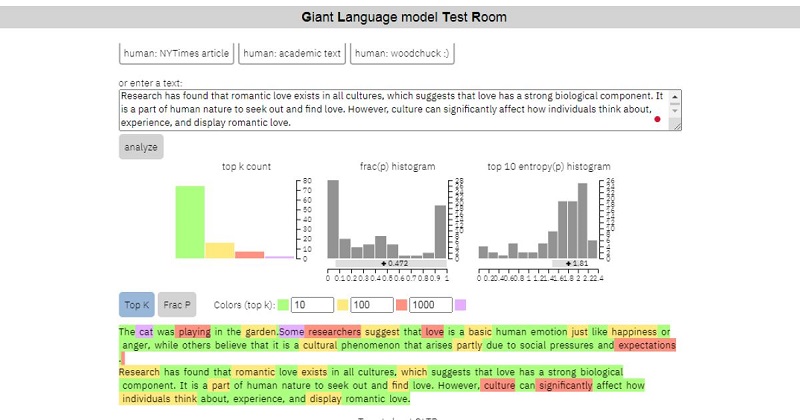
GLTR, short for Giant Language Model Test Room, is an AI detection tool developed by MIT-IBM Watson AI Lab and HarvardNLP. It is an excellent analysis tool for texts, helping users determine if AI created them.
Built on GPT-2 technology, this model analyzes each word by considering the context before the word and the probability of AI generating a specific sequence of words.
Pros:
- The tool color-codes text for more straightforward navigation, using green for the top 10 AI predictions, yellow for the top 100 predictions, red for the top 1,000 predictions, and violet for predictions beyond 1,000.
- It assesses the position of words to determine if AI was involved in their generation.
Cons:
- GLTR was developed in 2019 and may not be as efficient for newer AI technologies.
- Analyzing results may be challenging for first-time users, affecting the user experience.
Pricing: Free
Hugging Face
Hugging Face, a collaborative AI community provides an AI content detector within its platform for evaluating text originality. It classifies content as real (human-generated) or fake (AI-generated), with results presented in decimal points. Also, you can explore alternative recommendations for a different format preference for a better user experience.

Pros:
- The detector caters to tech-savvy users, offering a unique and engaging experience.
- It benefits from an open-source AI community, encouraging collaboration and diverse insights.
- Hugging Face is particularly effective for long AI-generated content.
- The tool is trusted by organizations such as Grammarly and Google AI.
Cons:
- Users less familiar with technical aspects may find the platform less intuitive.
- The clarity of results may not match other AI content detectors, potentially impacting user understanding.
- The tool is less effective for shorter content.
- You get results in decimals without specific area highlights.
Pricing: Free.
Copyleaks
What is the most accurate AI detector? The answer can be Copyleaks, one of the best AI detectors designed for businesses. With standout features, it distinguishes human and AI writing from diverse models like ChatGPT, GPT-4, Bard, or even AI+Human. The minimum length for this tool to scan is 350 characters.

Pros:
- The model provides precise insights into each sentence and helps you efficiently analyze content.
- It covers many models, including Bard and GPT-4, ensuring comprehensive AI content detection.
- Copyleaks is highly accurate, with a 99.1% overall accuracy and a meager 0.2% false positive rate, the best among all platforms.
- The tool supports 30 languages, making it versatile for multinational enterprises and source code analysis.
- You can download its Chrome extension for better use.
Cons:
- Some users experience slower result viewing than other tools.
- Copyleaks cannot exclude specific text parts from analysis, limiting customization for certain use cases.
Pricing: The cost is $9.16/month, covering 1,200 pages, with each page accommodating up to 250 words of scanned content.
Writer.com
For a straightforward and free AI writing detector without unnecessary features, Writer.com fits the bill. Users can easily copy and paste the text for analysis. Then, the tool will display a percentage showing whether the content is human- or AI-generated. Its maximum character limit is 1,500.

Pros:
- Writer.com offers a simple and user-friendly interface, making it easy for users to analyze text quickly.
- The tool allows users to analyze the origin of content through URLs.
- It includes a free grammar checker, enhancing its utility for content analysis.
Cons:
- Writer.com does not color-code AI- and human-generated sentences.
- There is no option to upload text files or images for analysis.
- It lacks the advanced content features that other tools provide.
Pricing:
- TEAM plan: $18 per user/month
- ENTERPRISE plan: Contact for details
Originality.ai
Originality.ai is a comprehensive solution offering an AI detector, a plagiarism checker, and fact-checking support. Further, it provides free readability tests to help you create easily understandable and engaging content. While primarily targeted at SEO agencies, the platform is suitable for anyone aiming to ensure their content is free from AI influence.

Pros:
- The platform allows users to share reports, facilitating collaborative efforts and efficient team communication.
- With features like adding coworkers to the platform and collaborative tools, Originality.ai is well-suited for team use.
- It achieves 99% on GPT-4 and 83% on ChatGPT, with a false positive rate of about 2%.
- A single scan can precisely assess the risk of AI-generated content on an entire website.
Cons:
- The pay-as-you-go model limits your options.
- Some users have reported inaccurate results, highlighting potential reliability issues with the tool’s checks.
Pricing:
- One-time payment: $30 for 3,000 credits (one credit scans 100 words).
- Base Subscription: $14.95/month for 2,000 credits (each additional credit is $0.01).
Content at Scale
Content at Scale’s AI detector provides a straightforward and uncomplicated method to evaluate text and determine if humans, AI, or a combination of both author it. Trained with diverse content, including blog posts, essays, Wikipedia entries, and thousands of articles, the tool delivers reliable and precise results.

Pros:
- With easy-to-interpret results, you can clearly understand which parts are likely AI-generated and which are human-written.
- The model can identify text generated by various tools like ChatGPT, Bard, Claude, etc.
- It goes beyond detection and allows you to rewrite AI-generated text to sound more human and improve your content.
- Content at Scale analyzes each sentence individually, enhancing the precision of its check.
Cons:
- The tool’s AI rewrites may not always be reliable and potentially affect the quality of the revised content.
- The rewrite feature is available in the Pro version only.
- In some cases, results may be unclear, posing a challenge for users in understanding the analysis outcomes.
Pricing: Available for free. Otherwise, you can buy subscriptions for more advanced features from $399/month.
Undetectable AI
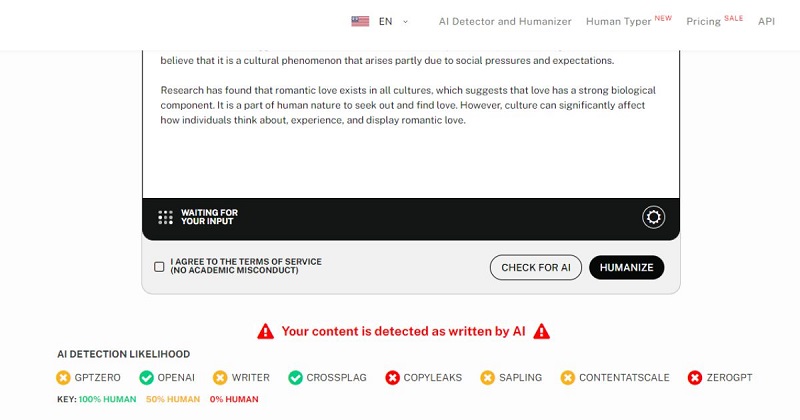
Undetectable AI stands out as a unique tool with dual purposes. It allows users to find AI content in their text while humanizing AI-generated portions to avoid detection. If the platform detects AI-generated parts, users can use the Humanize feature to transform them and bypass other AI detection tools.
Pros:
- The tool has a user-friendly design, providing a straightforward process for scanning and humanizing text.
- It recognizes text from various models such as GPT-3, GPT-4, Bard, Claude, etc., ensuring versatility.
- The tool supports up to 10,000 characters at a time, accommodating more extensive texts for analysis.
Cons:
- Some users find the pricing too high.
- This tool doesn’t give a score or percentage for AI content in the results, and it doesn’t highlight AI-generated parts.
Pricing:
- Free Version: Limited options with no text humanizer.
- Monthly Plan: $9.99/month for 10,000 words.
- Yearly Plan: $5/month for 10,000 words.
- For Business: Contact for more details.
Frequently Asked Questions
How to fact-check AI-generated content?
Follow these tips to fact-check AI-generated content:
- Cross-reference from various sources.
- Check the source’s credibility.
- Consider context and plausibility.
- Confirm the original publication date.
- Cite primary sources.
- Distinguish between facts and opinions.
- Consider EAT (Expertise, Authoritativeness, Trustworthiness) recommendations.
Is AI-generated content bad for SEO?
Google assures that AI-generated content won’t affect search rankings. They prioritize high-quality, original content based on expertise, authoritativeness, and trustworthiness. The focus is on content quality rather than how it’s made.
Final Thoughts
And that’s all we want to share about the 8 best AI detector tools for 2024. Even when Google doesn’t penalize AI-generated content, it’s crucial to ensure your content is original, relevant, engaging, and easy to read using those tools. Lastly, follow us – ROI Digitally for more valuable guidelines and instructions!

Jeng Nguyen has nearly 10 years of experience ranging from project management, operations, business development, customer service, content creation, video production, photography, website development, social media marketing, email marketing, advertising, SEO and sales.
Well-known as an ace Digital Marketing expert throughout various industries in Vietnam, Australia and the USA - Jeng is known for the success rate that he achieves whilst finding solutions tailored best for each unique business.
Jeng's mission is to revolutionize customer experience, starting with the journey of Attraction - Interest - Desire – Action. Together with a multi-expertise team at ROI Digitally, Jeng aims to provide businesses unprecedented breakthroughs in Return-on Investment from their customers.