
Key Takeaways
- Answer Engine Optimization (AEO) makes content easier for search engines to display as direct answers in featured snippets, knowledge panels, and FAQs. It relies on structured data, clear formatting, and concise answers, supported by AI and NLP models like Google’s BERT and MUM, to interpret intent and present content as quick, trusted responses.
- Generative Engine Optimization (GEO) builds on AEO for the AI era, ensuring content appears in AI-generated overviews and summaries across platforms like Google SGE, ChatGPT, Bing Copilot, and Perplexity. GEO focuses on entity optimization, authority building, and training AI to recognize brands as reliable sources, adapting to changing user behavior as AI-driven search grows.
- AEO vs GEO share an answer-first approach and value clarity, entities, and authority. AEO targets Google snippets and traditional SERPs, while GEO expands to generative platforms. AEO’s goal is to drive traffic through snippets, whereas GEO prioritizes visibility, credibility, and citations in AI outputs, even if clicks don’t follow.

To win in both AEO and GEO, you need technical SEO foundations plus AI-driven optimization that trains engines to recognize your brand as an authority.
ROI Digitally’s AI SEO Optimization Service combines schema markup, topical clustering, and entity optimization with AI-focused strategies, ensuring your business ranks in Google and is cited in AI-generated answers across platforms like ChatGPT, Bing Copilot, and Google AI Overviews. Explore our service now!
What Is AEO?
Answer Engine Optimization, or AEO, is all about making your content easy for search engines to turn into direct answers. Instead of just fighting for a spot in the list of blue links, AEO focuses on formats like featured snippets, knowledge panels, FAQs, and rich results, anywhere your content can appear as the quick, go-to answer.
The idea is simple: users want clear, instant responses, not endless clicking. To succeed with AEO, your content needs to directly answer common questions, be formatted in a scannable way (think lists, tables, and FAQs), and establish authority, especially on sensitive topics like finance or health.
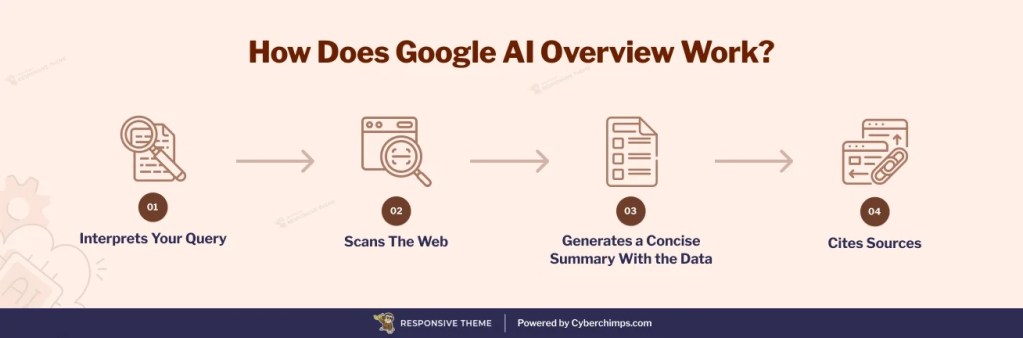
Google AI Overview and how it works. Source: Cyberchimps
The Algorithms Behind AEO
AEO works by tapping into the way search engines are evolving into answer engines, powered by artificial intelligence and natural language processing (NLP).
- Understanding user intent with NLP: Search engines don’t just match keywords anymore, they interpret meaning. For example, the query “How do I start a garden?” might trigger answers that cover soil preparation, plant selection, and watering schedules because the engine understands it’s more than a single question.
- AI and machine learning models: Platforms like Google use models such as BERT and MUM, while Bing integrates GPT-4, to process massive datasets and generate contextually relevant answers. These models learn how people ask questions and what information matters most.
- Structured data and knowledge graphs: Search engines also lean on structured data to connect the dots. Adding schema markup (like FAQ or how-to schema) helps engines recognize your content as a reliable source. Meanwhile, systems like Google’s Knowledge Graph pull verified facts from trusted sites to enrich their answers.
Put simply, AEO is about making your content easier for AI-powered search engines to understand, trust, and display as the direct response users see first.
What Is GEO?
Generative Engine Optimization, or GEO, is the next step beyond AEO. While AEO focused on getting your content into featured snippets or knowledge panels, GEO is about making sure your brand shows up in AI-generated overviews and summaries on platforms like Google’s Search Generative Experience (SGE), ChatGPT, Bing AI, and Perplexity.
The idea behind GEO is simple: train AI models to recognize your brand and content as trusted, authoritative sources so that when they generate answers, your information is cited. This is especially important now that more people are turning to AI-driven platforms for quick, conversational answers rather than scrolling through traditional search results.

GEO & how it works. Source: Akanksha Chandan – Medium
The Role of GEO In AI Search
GEO matters because search behavior is changing fast.
Gartner predicts that by 2026, traditional search volume could drop by 25%, with organic search traffic shrinking by over 50% as users adopt AI-powered search. Already, ChatGPT has more than 180 million monthly active users, and Perplexity AI’s growth has surged by over 850% in the past year.
This shift shows that users trust AI platforms to provide accurate, personalized information, and they’re using them for everything from research to product discovery.
For brands, the role of GEO is to adapt to this reality. By optimizing content for generative engines, you can:
- Reach audiences across both search engines and AI platforms.
- Deliver clearer, more relevant answers that AI can easily synthesize.
- Build authority and credibility as a trusted source.
- Stay competitive in a market where traditional SEO alone is no longer enough.
AEO vs GEO: An In-depth Comparison
When comparing AEO vs GEO, many people would misconcept the definition of what is AEO vs GEO.
AEO gained traction during the rise of zero-click search, when users got answers without leaving Google’s results page, and GEO emerged as a rebrand for the AI era, signaling that search rules are evolving beyond traditional SEO.
However, they overlap in several important ways:
- Answer-first mindset: Both approaches focus on delivering direct, useful responses to user queries rather than just ranking in traditional blue links.
- Content clarity and structure: Whether targeting a Google snippet or an AI overview, both require clear formatting, such as lists, tables, FAQs, and structured data, to help machines parse content.
- Entity focus: AEO and GEO both rely on clearly defining entities (brands, products, people, topics) so search systems can understand context and relationships.
- Trust and authority: Both strategies reward accurate, authoritative content, especially on sensitive topics where credibility is essential.

The difference between SEO vs AEO vs GEO. Source: Lollypop Design Studio
Yet, the two terms, at its core, share different purposes in AI search era.
So, what is the difference between AEO and GEO?
1. Primary Goal
- AEO (Answer Engine Optimization): Focuses on optimizing for direct answers in search results. Think Google’s featured snippets, knowledge panels, or FAQs that appear above the traditional blue links.
- GEO (Generative Engine Optimization): Expands this into the AI era, optimizing for AI-generated overviews and citations across platforms like Google SGE, ChatGPT, Perplexity, and Bing Copilot.
2. Platform Focus
- AEO: Primarily designed for Google’s search environment. Its tactics revolve around earning placement in featured snippets, knowledge panels, and voice search answers.
- GEO: Covers a wider range of AI-driven platforms, from conversational search engines to generative assistants. Its scope goes beyond Google to include Bing AI, Gemini, and Perplexity.
3. Tactics
- AEO: Relies heavily on structured data, FAQ schema, concise answers, and keyword matching to increase the chance of appearing in snippets or knowledge panels.
- GEO: Uses entity optimization, credibility building, and AI-friendly formatting to ensure content is recognized and cited by AI systems. Rather than only extracting a snippet, these platforms synthesize information into summaries.
4. Focus on Clicks
- AEO: Designed to drive traffic. Featured snippets aim to attract clicks back to the site, even if some users stop at the snippet itself.
- GEO: May or may not drive clicks. AI-generated answers often provide complete responses without requiring users to leave the platform. The value lies in visibility, authority, and brand citations, even without a direct click.
5. Timeframe and Context
- AEO: Coined in the pre-AI search era, when optimization was mainly about adapting to Google’s early move toward answer-first search results.
- GEO: Developed for AI-enhanced search, recognizing that generative engines now play a central role in how people discover and consume information.
In short, AEO and GEO are part of the same shift: moving from keyword-heavy SEO toward optimization that meets user intent and aligns with how modern algorithms and AI models interpret language.
But the difference between them is mainly about the search environment they were designed for: AEO was built for Google’s answer-first results, like featured snippets, while GEO was created for AI-powered search engines that generate summaries and conversational answers.