
Key Takeaways
- Google algorithm updates shape how your site ranks. Understanding what is Google algorithm helps you stay ahead in SEO. Each update targets specific issues like spammy links, weak content, or poor user experience.
- Not all updates affect everyone equally. Some Google algorithm updates target local search, mobile performance, or expert-level content. Knowing which ones apply to your site helps you improve the right way.
- Great SEO means adapting to change. What worked yesterday may not work tomorrow. Keeping up with Google algorithm updates helps protect your traffic, improve rankings, and stay competitive.

Google algorithm. Source: SEO Discovery
Want help navigating Google algorithm updates and staying ahead of SEO changes? Let ROI Digitally take care of it. Visit roidigitally.com to optimize your rankings the right way.
What Is Google Algorithm?
If you’ve ever wondered what is Google algorithm, think of it as the brain behind every Google search. It’s a complex system made up of hundreds of rules and calculations that decide which websites show up, and in what order, whenever you search for something.
More specifically, the Google algorithm looks at your search query, scans its massive index of web pages, and instantly ranks the most relevant, useful, and trustworthy results. It considers things like keyword relevance, content quality, page speed, backlinks, mobile-friendliness, and many other signals.
What Is Google Algorithm for SEO?
For SEO professionals and website owners, the Google algorithm is a major player. It decides how visible your website is on Google, which means it directly affects your traffic, leads, and online success. Understanding what is Google algorithm for SEO means understanding how to optimize your site to match Google’s criteria for quality and relevance.
If your site aligns with what Google considers valuable, fast load times, high-quality content, and good user experience, you’re more likely to rank higher. If it doesn’t, your rankings can drop.

How Google Algorithm impact SEO ranking factors. Source: Aha! Elliance Blog – Elliance
Why Google Algorithm Updates Matter
Google doesn’t just set its algorithm once and leave it alone. It makes thousands of changes every year, some small, others massive. A Google algorithm update can shift how pages are ranked overnight.
That’s why staying updated matters. If you know how Google’s algorithm is changing, you can adjust your SEO strategies in time, whether it’s rewriting low-quality content, fixing site speed, or improving mobile usability.
Failing to adapt to a major Google algorithm update can mean sudden drops in search visibility and traffic. But keeping up with these changes helps you stay compliant, competitive, and consistent in the search results.
Top 10 Google Algorithms You Must Know
1. Google Panda (2011)
Google Panda was created to help users find better, more trustworthy content online. Before Panda, low-quality websites filled with copied or poorly written content often showed up high in search results. That made for a frustrating experience.
This Google algorithm update focused on spotting “thin content”, pages with little useful information, lots of ads, or duplicate text. If a website had too much of this, Panda would push it down in the rankings. That made room for more helpful, well-written content to rise to the top.
It also encouraged web creators to think beyond keywords. The goal became about writing for people first, not just for search engines. So if you’re wondering what is Google algorithm for SEO, Panda taught everyone that quality matters most.

Google Panda was first launched in 2011. Source: Search Engine Land
2. Google Penguin (2012)
Google Penguin came in to clean up messy backlink practices. In the past, people could buy links or create tons of fake backlinks to boost their rankings. Penguin changed that game.
This Google algorithm checked where links came from. If they were part of a shady link scheme or irrelevant to the website’s topic, Penguin would flag them. That website’s search ranking could drop fast.
What Penguin taught us is that link quality matters much more than quantity. For SEO today, building real, helpful connections through backlinks is essential. It also showed how a Google algorithm update can reshape SEO link building strategies almost overnight.
3. Google Hummingbird (2013)
Google Hummingbird made the search engine smarter. Instead of just matching words in your search, Hummingbird tries to understand what you meant. It focused on search intent.
For example, if you typed “best way to cook salmon,” Hummingbird helped Google show results that explain techniques, not just pages with those exact words.

Google Hummingbird algorithm through the search results page. Source: SEO agency
This update made SEO shift towards natural language. It also opened the door for voice search and conversational queries. If you’re creating content today, you need to think like your audience and answer questions directly. That’s what Google algorithm for SEO now rewards: understanding the user, not just their words.
4. Google Pigeon (2014)
Google Pigeon focused on local search. It made results more accurate when people searched for things nearby, like “pizza place near me” or “plumber in Chicago.”
Pigeon used the searcher’s location and local business data (like address, reviews, and online directories) to show results that were geographically relevant.
This Google algorithm update helped small businesses compete locally. If your business has a physical location, this makes local SEO and things like Google My Business listings more important than ever.
For SEO strategies, this meant your presence in local directories, consistency of your contact info, and customer reviews started affecting your rankings more than before.
5. Google Mobilegeddon (2015)
In 2015, Google made mobile-friendliness a major ranking factor. Known as “Mobilegeddon,” this Google algorithm pushed sites that were hard to use on phones lower in mobile search results.
Websites that weren’t optimized for smaller screens, tiny fonts, links too close together, and slow loading times were hit hard.

The Google Mobilegeddon (2015) was the first move by Google on mobile usage. Source: The Guardian
The goal was to improve the user experience for mobile users. With most searches now happening on phones, Google wanted to make sure users weren’t frustrated.
For SEO, this meant mobile-first design became the standard. If your site isn’t easy to use on mobile, your rankings can suffer, no matter how good your content is.
6. Google RankBrain (2015)
RankBrain was Google’s first algorithm to use machine learning. That means it learns from how people interact with search results and adjusts over time.
This Google algorithm helps Google understand unfamiliar or complex queries. Even if a keyword has never been searched before, RankBrain uses context and past behavior to guess what the user wants.
This update made SEO more about user intent than keyword stuffing. It pushed content creators to be more helpful, not just technically optimized.
7. Google Possum (2016)
Possum expanded local search results by factoring in geographic diversity. Before this Google algorithm update, businesses just outside a city border had trouble showing up in city-based search results. Possum fixed that.
Now, Google considers proximity, how close a business is to the searcher, more seriously. It also added more variety to local results. Two businesses offering the same service won’t always both show up unless they’re very different in location or content.
For SEO, this means local optimization has to go beyond just keywords. You need unique content, good reviews, and strong location signals like maps, citations, and local links to stand out.
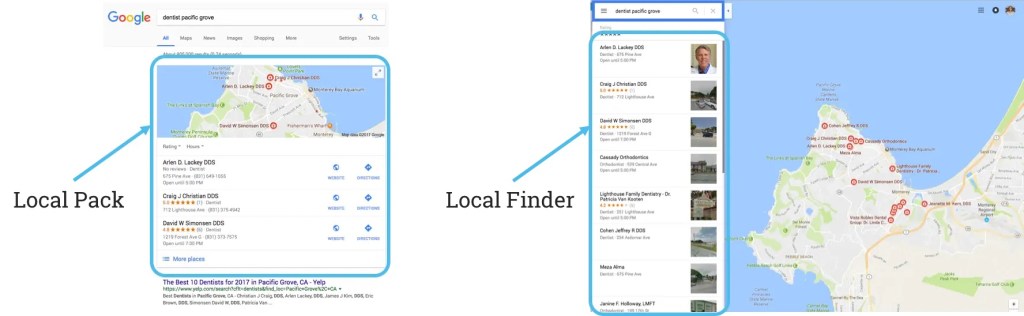
Google Possum has revolutionized local search. Source: Moz
8. Google Medic Update (2018)
The Medic update mainly affected Your Money or Your Life (YMYL) websites, those dealing with health, finances, or safety. These are areas where poor information can really hurt someone.
This Google algorithm aimed to show only high-trust, expert-level content for those sensitive topics. It pushed down sites that lacked authority, had no credible author info, or didn’t cite trusted sources.
To rank well post-Medic, websites need to focus on E-A-T: Expertise, Authoritativeness, and Trustworthiness.
If your website gives advice on serious matters, it should be written by qualified professionals, backed by real research, and clearly show who is responsible for the content. That’s what Google algorithm for SEO now prioritizes in high-risk industries.
9. Google BERT (2019)
BERT was a huge leap in language understanding. It stands for Bidirectional Encoder Representations from Transformers, but all you need to know is that it made Google better at interpreting context.
Before BERT, Google looked at search terms word by word, in order. With BERT, it can look at the whole sentence and understand how words relate to each other, even small words like “to” or “for.”
This was especially helpful for longer, more natural searches like “can you get medicine for someone at a pharmacy?” BERT knows the query is about rules for someone else, not yourself.

Google BERT changes how Google understands natural language. Source: Search Engine Land
As a content creator, this means writing clearly, using natural language, and answering questions directly is the best way to match search intent. That’s where the future of Google algorithm is headed.
10. Google Page Experience Update (2021)
The Page Experience update focused on how people feel when visiting your website. Google now uses signals like how fast your page loads, how stable it looks while loading, and whether it’s easy to interact with.
It introduced metrics called Core Web Vitals, which measure loading speed, interactivity, and visual stability. If your page moves around a lot while loading or takes forever to respond, that’s bad for SEO.
This Google algorithm update also favors mobile usability, HTTPS security, and websites that avoid annoying pop-ups.
For SEO, this means that technical optimization, like improving speed, mobile responsiveness, and layout, matters just as much as content quality. It’s all about user experience now.
You need to protect your website from Google’s algorithms: Experience SEO Outsourcing Service at ROI Digitally now.

Jeng Nguyen has nearly 10 years of experience ranging from project management, operations, business development, customer service, content creation, video production, photography, website development, social media marketing, email marketing, advertising, SEO and sales.
Well-known as an ace Digital Marketing expert throughout various industries in Vietnam, Australia and the USA - Jeng is known for the success rate that he achieves whilst finding solutions tailored best for each unique business.
Jeng's mission is to revolutionize customer experience, starting with the journey of Attraction - Interest - Desire – Action. Together with a multi-expertise team at ROI Digitally, Jeng aims to provide businesses unprecedented breakthroughs in Return-on Investment from their customers.