Key Takeaways
- The Google Knowledge Graph is Google’s way of connecting facts about people, places, brands, and things to deliver smarter, more accurate search results.
- Being included in the Google Knowledge Graph helps businesses gain visibility in knowledge panels, featured snippets, and AI-driven search, while also reducing confusion around similar names.
- To learn how to build a knowledge graph for your brand, focus on website authority, schema markup, online presence, backlinks, and claiming existing listings to strengthen trust and consistency.

Google Knowledge Graph. Source: Appnovation
What Is Google’s Knowledge Graph?
The Google Knowledge Graph is basically Google’s way of making sense of the world so it can give you better answers. Instead of just matching the words you type into the search bar, it looks at the meaning behind them.
So, what is Google’s Knowledge Graph? Think of it as a giant web of connected facts. Every “entity,” whether it’s a company, a person, a product, a place, or even an idea, is treated as a node in this web. These nodes are linked together based on how they relate to each other.

Example of Google Knowledge Graph. Source: Semrush
This network of relationships is why you often see structured answers in the form of Knowledge Panels, People Also Ask boxes, or even autocomplete suggestions. Launched in 2012 with the idea of focusing on “things, not strings,” the Knowledge Graph turns raw data into meaningful knowledge, making search results clearer, faster, and more useful.
For example, if you search for “Amazon,” Google needs to figure out whether you mean the rainforest or the online store. The Knowledge Graph helps it understand the context by looking at connections:
- Amazon (the company) → sells → products
- Amazon (the rainforest) → hasTreeCover → 2.3 million square miles
Learn more about how Google Knowledge Graph works here: https://support.google.com/knowledgepanel/answer/9787176?hl=en#
Why Is Google Knowledge Graph Necessary?
The Google Knowledge Graph matters because it shapes how Google understands and presents your business online. In short, it decides what Google believes to be true about your company. If your business is recognized as a verified entity inside the graph, you stand a much better chance of showing up in search features like knowledge panels, featured snippets, voice results, image carousels, and even AI-generated summaries.
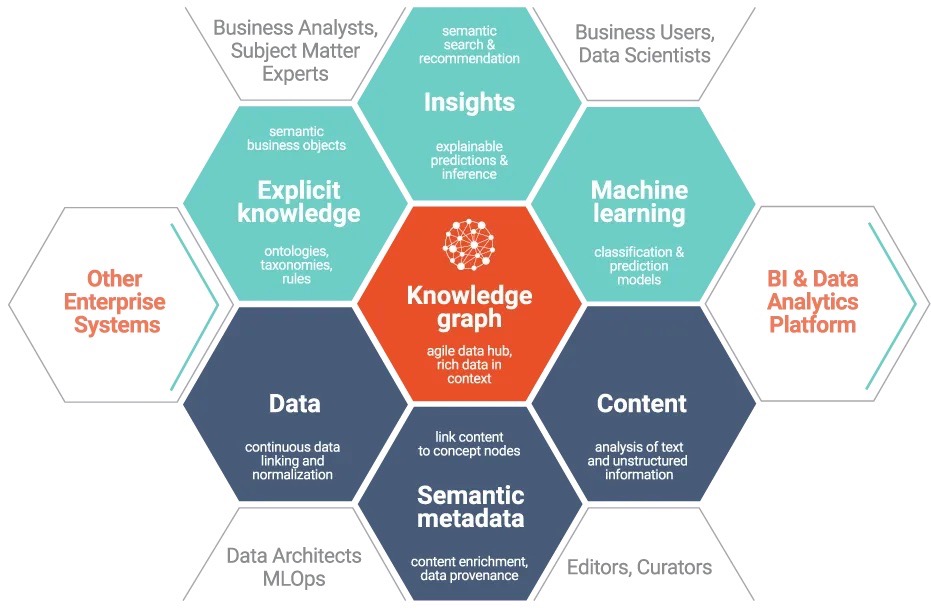
The benefits of a Knowledge graph. Source: OntoText
Why is this necessary?
Because it reduces confusion and builds trust, imagine two companies with the same or similar names, without the Knowledge Graph, Google might mix them up. By treating your business as an entity, Google can clearly separate you from others and ensure users get accurate information.
It also boosts visibility. Whether people search directly for your brand or use related terms, being part of the Knowledge Graph helps Google highlight your company in more prominent, trustworthy ways. This happens because Google doesn’t just rely on one source of truth, it will cross-checks multiple signals:
- Your website: clear descriptions of who you are and what you do.
- Structured data: schema markup to tell Google exactly what the content represents.
- Wikidata & public databases: trusted references that confirm your details.
- Social media & directories: consistent logos, links, and business info.
- Press, case studies, or third-party mentions: external validation from reliable sources.
When all of these sources line up, Google gains confidence in your business profile and locks it into the Knowledge Graph.
Want your business recognized as a trusted entity in Google’s Knowledge Graph? ROI Digitally’s SEO experts can help you structure, optimize, and build authority so you appear where it matters most. Discover how we grow visibility today!
How To Optimize For Google Knowledge Graph
1. Have A Strong Website Base
When it comes to how to build a knowledge graph, the first step is laying down a strong website foundation. Why? Because the Google Knowledge Graph only trusts information that’s consistent, accurate, and user-focused. If your site isn’t solid, Google has no reason to recognize your business as a reliable entity.
That starts with the basics of SEO. Your website needs to be clear, structured, and built for people, not just search engines. Here’s what matters most:
- Topical authority through content clusters – Organize your content into themes so Google and users see how everything connects. This makes your site more trustworthy and keeps visitors exploring longer.
- Internal linking structure – Use a logical layout with clear navigation. The easier it is for Google and users to find key information, the more likely it is to appear in search features.
- Fresh, user-focused content – Don’t just recycle what competitors write. Create original, timely content that answers real user questions. This proves your site is active and relevant.
And of course, don’t forget the basics: mobile-friendliness, on-page SEO, and keyword research. By building this strong foundation first, you’re giving Google the right signals to pull your brand into the Google Knowledge Graph.
Learn more: What Is Technical SEO? A Deep Dive Into SEO Factors
2. Utilize Schema Markup
If you’re wondering how to build a knowledge graph, one of the most effective steps is using schema markup. Schema is like a translator that helps Google clearly understand what your website content means. This is critical because the Google Knowledge Graph relies on structured data to verify facts about your business.

The schema market is the basis of building your website. Source: Google for Developers
Start with the basics: the “Organization” schema. This tells Google who you are, where you’re located, and the important details about your brand. From there, you can add other schema types that fit your business, like “LocalBusiness,” “Service,” or “Person.” Each one adds another layer of clarity and credibility.
It’s also important to check the health of your structured data.
You can do this in Google Search Console, under the “Enhancements” tab, where you’ll see which schemas are detected and whether they have errors. Cleaning up those errors ensures Google can trust and use your data effectively.
By properly applying and validating schema, you’re making it easier for Google to confirm your business details and strengthen your presence in the Google Knowledge Graph.
3. Enhance Your Online Presence
Strengthening your online presence is a must when it comes to building the Google Knowledge Graph. Why?
Because Google doesn’t just look at your website. Instead, it pulls information from across the internet to decide how trustworthy and relevant your brand really is.
That’s where reputation management comes in. It’s more than replying to reviews; it’s about making sure every piece of information about your business online is consistent and reliable.
Here’s how to do it:
- Google Business Profile Optimization – Claim and verify your profile, then keep it updated. Reviews, customer sentiment, and frequent updates help Google trust your listing and connect it to your brand identity.
- Get listed on trusted sources – Sites like Wikipedia, LinkedIn, Crunchbase, Bloomberg, and Yahoo act as authority signals. When Google finds the same details about your business across these platforms, it strengthens your entity in the Knowledge Graph.
- Monitor Reddit & Quora – These platforms now appear more often in search results. A negative thread can show up right next to your site. Treat them like customer reviews: respond, engage, and track what people are saying about your business.
4. Implement Backlinks & Marketing Entities
Backlinks and partnerships act like bridges, linking your business to the wider web of trusted entities that shape how Google understands and ranks you.
If your company is mentioned on review sites, listicles, or industry roundups, Google sees those link building as validation that your business is part of the bigger picture.
For example, once a search result shows “top startup marketing agencies,” there is a high potential that the brands included there likely earned that placement by being consistently referenced in trusted sources.

Implement backlink or social links to increase the page’s trustworthiness. Source: Pod Digital
To optimize for this, you need to:
- Build partnerships with relevant sites – Collaborate with publications, blogs, or organizations in your niche so your brand is naturally included where competitors already appear.
- Secure high-quality backlinks – Focus on links from reputable, authoritative sites that reinforce your expertise and credibility.
- Associate with the right entities – Identify which brands, organizations, or industry groups Google already connects within your space, and work on being linked alongside them.
By weaving your brand into these external networks, you give Google stronger evidence to include you in knowledge panels, featured results, and other rich features of the Google Knowledge Graph.
Learn more: 8 Proven Link Building Strategies Marketers Should Utilize
5. Don’t Miss The Current Listing
If Google has already created a knowledge panel for your business, don’t leave it unattended, claim it. Verifying ownership with Google allows you to manage the panel, suggest edits, and make sure all the details about your brand are accurate and up to date.
This step might seem small, but it’s powerful.
By actively managing these listings, you’re strengthening the connections inside the Google Knowledge Graph. Each update signals to Google that your brand information is consistent, verified, and trustworthy. The more stable and accurate your entity appears, the better Google can represent it across search results.
Put simply: claiming your existing listings is like securing your spot in Google’s database. It ensures your brand’s story is told the right way, not left to chance.
Building authority in Google’s Knowledge Graph starts with the right SEO strategy. Don’t leave your brand’s visibility to chance — partner with ROI Digitally, your ROI-driven marketing team. Start here!
Frequently Asked Questions
- Does Google still use Knowledge Graph?
Yes, Google still relies heavily on the Google Knowledge Graph. Since its launch in 2012, it has become the backbone of features like knowledge panels, autocomplete, “People Also Ask” boxes, and now AI-driven search results.
- How does the Google Knowledge Graph work?
The Google Knowledge Graph works by connecting entities, such as people, brands, products, and places, into a massive web of facts. For example, it can tell whether “Amazon” refers to the rainforest or the company, based on context. This makes search results smarter and more reliable.
- How do I get into Google’s Knowledge Graph?
To be included in Google’s Knowledge Graph, your business or entity must appear consistently across trusted sources. Start with a strong website, use structured data (schema markup), maintain active profiles on platforms like LinkedIn and Wikipedia, and ensure directory listings are accurate. Verified social profiles and press mentions also help Google recognize your entity and add it to the graph.
- Is Google Knowledge Graph API free?
Yes, the Google Knowledge Graph API is free to use, but it has certain limits on requests. Developers can use it to search entities, pull information from the Knowledge Graph, and integrate it into applications. Yet, high-volume or enterprise-level usage may require applying for higher quota access through Google Cloud.