
Key Takeaways
- SEO measurement involves tracking key metrics, such as organic traffic, keyword rankings, and conversion rates, to evaluate how well your website performs in search engine results.
- Some key SEO measurement metrics include keyword rankings, organic traffic, conversion rate, and return on investment (ROI). These metrics give you valuable information about how your SEO strategies are performing, from attracting traffic to converting visitors into customers.
- SEO measurement tools, such as Google Analytics, Google Search Console, and SE Ranking, provide detailed insights into website performance. These tools help monitor traffic, track keyword rankings, and analyze user behavior, which are essential for measuring SEO success.

SEO Measurement. Source: Scalenut
For more insights and to optimize your SEO strategy, check out ROI Digitally.
What Is SEO Measurement?
SEO measurement is the process of tracking and analyzing various SEO metrics to evaluate how well your website is performing in terms of search engine optimization. These metrics provide insights into how your SEO efforts are affecting traffic, leads, conversions, and your overall online visibility.
By using SEO measurement tools, marketers can:
- Track the performance of their campaigns and identify areas for improvement.
- Spot their website’s strengths and weaknesses to make better SEO decisions.
- Keep up with Google updates and adapt strategies to maintain or improve rankings.
- Discover growth opportunities based on data-driven insights.
Key SEO Measurement Tools
SEO measurement tools are essential for tracking how well your website is performing in search engine optimization. These tools help you monitor key SEO measurement metrics, so you can adjust your strategies and improve your rankings.
Using these SEO measurement tools, you can stay ahead of changes like Google’s algorithm updates, identify areas of weakness, and fine-tune your strategies to maintain or improve your SEO performance.
Here are some powerful SEO measurement tools that can help you keep track of your performance:
- Google Analytics (GA): This free, advanced tool helps you track website traffic and gain insights into user behavior. It shows where your traffic is coming from, how users interact with your site, and where you can make improvements to increase conversions.
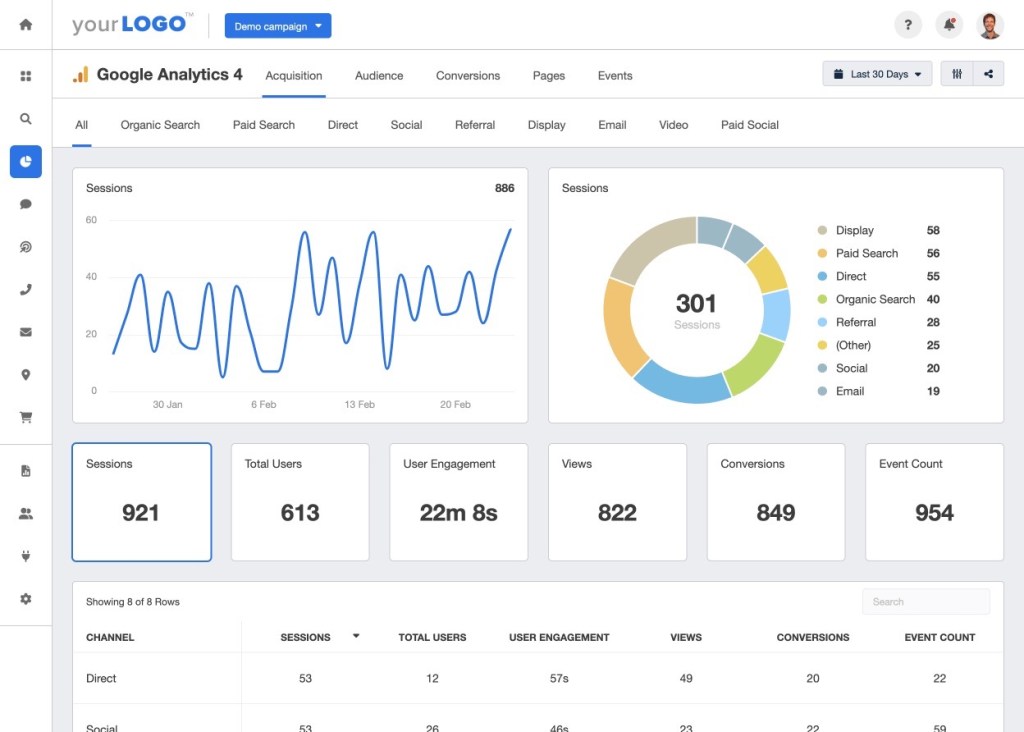
Google Analytics. Source: AgencyAnalytics
- Google Search Console (GSC): GSC is a must-have for managing your website’s presence in Google’s search results. It helps you monitor which pages are being indexed, how your site is performing, and which domains are linking to your pages. You can even pull data into Google Sheets for deeper analysis and reporting.

Google Search Console (GSC). Source: Google for Developers
- All-in-one SEO Software: These tools offer a comprehensive SEO analysis, from checking keyword rankings to conducting in-depth site audits. They can also monitor backlinks, helping you understand the health of your SEO and where to make adjustments for better results.

SEMrush, one of the popular SEO Measurement tools. Source: Leanne Wong
5 SEO Measurement Metrics For Performance
- Keywork Rankings
Keyword rankings are one of the most important SEO measurement metrics for understanding how well your site is performing in search engine results. By tracking where your site ranks for specific keywords, you can get a clear picture of how visible your website is to potential visitors.
Here’s why keyword rankings are so valuable for measuring SEO success:
- Understanding Traffic Sources: Keyword rankings help you see exactly how users are finding your website. You’ll know which search terms are bringing visitors, giving you insight into how well your content aligns with user searches.
- Competitive Analysis: Monitoring keyword rankings also lets you see where your site stands in comparison to your competitors. If your rankings drop or if competitors perform better, you’ll know where to adjust your strategy. Google algorithm updates can affect rankings, so it’s essential to keep track of any changes.
- Actionable Insights: Using SEO measurement tools like SE Ranking, you can get detailed information on your keyword positions, the pages that drive the most traffic, and even discover emerging keywords to target.
- Search Intent: Make sure to consider search intent when choosing keywords for your website. For instance, ensure that your keywords match what users are actually looking for. By aligning content with search intent, you increase the chances of converting visitors into customers.

Keywords ranking tracking on Ahrefs. Source: Ahrefs
- ROI
Return on Investment (ROI) is an important metric in SEO that helps you measure the effectiveness of your SEO campaigns in terms of profit.
Simply put, ROI is a way of comparing how much you earn from your SEO efforts to how much you spend on them.
For example, if you invest $10,000 into SEO and earn $1 million in revenue from the resulting traffic, your ROI would be an impressive 9,900%. This ratio helps you evaluate whether your SEO efforts are delivering tangible business results.

What is return on investment (ROI). Source: Salesbook
To calculate SEO ROI, there are two key steps.
First, you need to determine the revenue directly attributed to your SEO efforts. This could include sales, leads, or any other measurable outcome driven by organic search traffic.
The second step is to account for the total cost of your SEO campaigns, including investments in tools, content creation, link building, and any other expenses incurred.
By subtracting the cost from the revenue and dividing by the cost, you get a clear understanding of how much you are earning for every dollar spent on SEO.

ROI Calculation. Source: Yespo CDP
Tracking conversions is also an essential part of measuring SEO ROI.
It’s crucial to know how much each conversion is worth to your business.
A conversion could be a sale, a lead, or any other defined goal, and understanding its value helps refine your ROI calculation. SEO measurement tools like Google Analytics, SEMrush, and Ahrefs are essential in tracking this data and understanding your traffic and conversion patterns.
The real benefit of measuring ROI in SEO is that it helps you identify areas where you’re losing potential sales or traffic. This is where optimizing the customer journey becomes crucial.
- Conversion Rate (CR)
When measuring SEO performance, Conversion Rate is a key metric that shows how effective your website is at achieving specific goals.
In simple terms, a conversion happens when a visitor to your site takes a desired action, whether it’s filling out a contact form, signing up for a newsletter, or making a purchase. These actions are defined as valuable to your business and are the primary goal of optimizing your website.
To calculate Conversion Rate, divide the total number of conversions by the total number of visitors.

Conversion rate calculation. Source: Wall Street Prep
For example, if 1,000 people visit your website and 100 of them sign up for your newsletter, your conversion rate is 10% (100 conversions ÷ 1,000 visitors).
This gives you a direct understanding of how well your website content is turning visitors into actual goal completions.
The higher the conversion rate, the more efficiently your website guides users toward actions that benefit your business.
SEO measurement tools, like Google Analytics, are great for tracking this metric, as they provide insights into which pages and actions lead to conversions and which don’t.

Google Analytics can track Conversion Rate. Source: Smart Insights
Once you understand your conversion rate, you can further optimize your website. For instance, if your conversion rate is low, it could indicate that your content is not compelling enough or that your call-to-action (CTA) is unclear.
How to measure SEO success often involves adjusting these elements to make sure they resonate with your target audience. A key strategy is to improve your CTA, make sure it’s action-inspiring and easy to understand.
An effective CTA guides visitors to take action confidently and is usually paired with eye-catching elements like bold text or an arrow pointing directly to the button.
- Organic Traffic
Organic traffic is one of the most critical SEO metrics because it indicates how many visitors come to your site through unpaid search engine results.
When someone types in a search query related to your business or website, and they click on your link in the search results, that’s organic traffic. These visitors are valuable because they find your site through search engines like Google, Bing, or Yahoo, rather than through paid ads.
Tracking organic traffic helps you understand how well your site performs in search engines and how effectively your content attracts visitors.
SEO measurement tools, such as Google Analytics, are essential for monitoring organic traffic. These tools allow you to track the flow of visitors to your site, analyze their behavior, and understand which keywords or pages drive the most traffic.

Organic traffic analyzed by GA4. Source: MeasureU
You can track the dynamics of this traffic over time, noting any increases or decreases.
For example, you might observe that certain pages are consistently attracting a lot of organic traffic, or that traffic from specific countries is growing. This information can help guide your online promotion strategy.
Understanding where your traffic is coming from, whether from specific countries, search engines, or pages, can give you insights into what’s working and where there are opportunities to optimize further.
To measure SEO success using organic traffic, it’s important to look at more than just the number of visitors.
You should also analyze metrics such as the number of sessions, average session duration, and user engagement, including clicks, scrolls, and page interactions. These deeper insights help you assess the quality of the traffic you’re getting, not just the quantity.

Measuring other key metrics like Average session duration to support organic traffic performance. Source: AUQ.io
If your website has Google Analytics installed, you can dive into detailed reports in the “Acquisition” and “Engagement” sections. These sections show how visitors found your site, how long they stayed, and how they interacted with your content.
With this data, you can tweak your SEO strategy to focus on areas that drive the most meaningful traffic.
- Core Web Vitals
Page experience metrics are a crucial part of SEO measurement because they directly affect how users interact with your website. These metrics focus on the quality of the experience users have when they visit your pages, which in turn influences how well your site ranks in search engines like Google.

Core web vitals need to be carefully tracked. Source: Wolfenden
The goal is to ensure that users have a smooth, fast, and engaging experience across all devices. Google uses these page experience metrics to determine how well a page meets user expectations, rewarding sites that offer a seamless experience with higher rankings.
One of the key aspects of page experience is Core Web Vitals, which are a set of metrics that measure loading speed, visual stability, and interactivity. These metrics help determine how quickly your page loads, whether it shifts while loading, and how easily users can interact with it.
A fast-loading, stable, and responsive page improves user satisfaction, which in turn leads to better engagement and retention.
In addition to Core Web Vitals, other factors, such as mobile friendliness and website security, also play a significant role in page experience. Since most users now browse websites on mobile devices, it’s essential that your site is optimized for mobile use.

Mobile friendliness, website security, or page load speed are among the technical SEO factors that require regular monitoring. Source: Upwork
A mobile-friendly site ensures that users can easily navigate and interact with your content, regardless of the device they are using. Moreover, website security, such as HTTPS encryption, builds trust and is an important ranking factor for Google.
To track these SEO measurement metrics, Google Search Console (GSC) is a valuable tool.
GSC provides detailed reports on how real users interact with your website and highlights any areas where your page experience may be lacking. It offers insights into which pages need improvement, helping you prioritize fixes that could boost your page’s overall performance.
GSC is a crucial analytical tool for SEO, particularly in technical SEO. Source: SEOTesting
A key pro tip for improving page experience is page speed.
A slow website can frustrate users, harm your SEO rankings, and even hurt your brand reputation. To improve speed, consider reducing the size of your HTML, CSS, and images, and using rel tags to separate resources. This can help your pages load faster, enhancing both user experience and SEO performance.
Frequently Asked Questions
- What is SEO measurement?
SEO measurement refers to the process of tracking and analyzing various factors that contribute to a website’s visibility and performance in search engine results.
It involves monitoring key metrics such as organic traffic, keyword rankings, conversion rates, and user engagement to evaluate the effectiveness of SEO efforts.
By measuring these aspects, you can determine how well your SEO strategies are working and identify areas for improvement. This helps in making informed decisions to optimize your website for better rankings, user experience, and ultimately, business growth.
- How is SEO calculated?
SEO is calculated by tracking a variety of metrics that influence how well a website performs in search engine results. Key metrics include organic traffic, keyword rankings, backlinks, bounce rate, and conversion rate.
For example, you can calculate your website’s SEO performance by analyzing how much organic traffic comes from specific keywords, the position of those keywords in search engine results, and how often users interact with your content.
Tools like Google Analytics and Google Search Console can help calculate these metrics, giving you a clearer picture of your SEO success and areas for improvement.
- What is KPI measurement for SEO?
KPI (Key Performance Indicator) measurement for SEO refers to tracking specific metrics that align with your website’s SEO goals. KPIs help determine how well your SEO efforts are contributing to your overall business objectives. Common SEO KPIs include organic traffic, keyword rankings, click-through rate (CTR), bounce rate, and conversion rate.
By measuring these KPIs, you can evaluate how effectively your SEO strategy is driving traffic, engaging visitors, and achieving business goals like sales or leads. Regularly monitoring KPIs helps ensure that SEO efforts are on track and delivering the desired results.
- What is the tool to measure SEO?
There are several tools available to measure SEO performance, with Google Analytics and Google Search Console being the most widely used.
Google Analytics tracks website traffic, user behavior, and conversions, helping you understand how visitors interact with your site. Google Search Console provides detailed insights into your site’s performance in search results, including keyword rankings, impressions, and click-through rates.
Other popular SEO measurement tools include SEMrush, Ahrefs, and Moz, which offer in-depth analysis of backlinks, keyword rankings, and overall site health. These tools are essential for evaluating SEO effectiveness and making data-driven decisions.