
Domain Authority (DA) is significant in SEO as a metric for gauging a website’s ranking potential. This article will explore the 5 latest methods of improving domain authority and the best DA checkers. Let’s unravel the mystery behind Domain Authority and use it effectively in your SEO strategy.
What Is Domain Authority?
Domain Authority (DA), a pivotal metric developed by Moz, is a valuable predictor of your website’s potential ranking in search engines. It measures your site’s relevance within your industry or a specific topic, essentially measuring the strength and authority of your domain.
On a scale from 0 to 100, your domain authority score reflects the possibility of your website’s success in search results—the higher the score, the better the performance. However, it’s crucial to note that while DA is a helpful indicator for benchmarking against competitors, Google does not use it in determining website rankings.
The DA metric is calculated by assessing various factors, such as linking root domains and total links, into a single score. This score is valuable for comparing websites or tracking a site’s “ranking strength” over time.

The score calculation relies on a machine learning algorithm predicting a domain’s frequency in Google SERPs. The nature of machine learning means your site’s DA may fluctuate with changes in available data points.
For instance, if a site like ROI Digitally acquires numerous new links, other sites’ DAs may drop. As authoritative domains dominate high-DA slots, growing your score is comparatively easier at lower levels than at higher ones. Therefore, it’s crucial to view Domain Authority as a comparative metric rather than an absolute one.
As you learn how to increase domain authority, understanding these intricacies is the foundation to improve your off-page SEO strategy. In the next section, we’ll talk about authority domains.
How Do You Know If Your Site Is An Authority Domain?
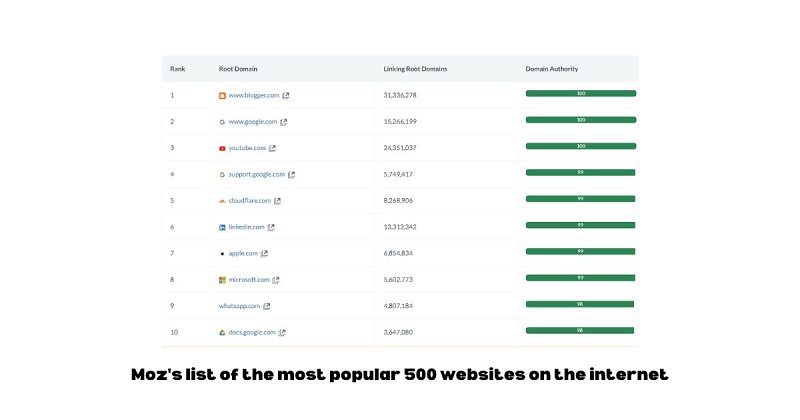
A practical way to know whether your site holds authority is by comparing your DA to well-established websites like Google, Apple, or Microsoft, which typically have high DAs ranging from 90 to 100. Conversely, new websites may be in the lower spectrum, with DAs between 10 and 20.
However, while Domain Authority operates on a 100-point scale, labeling scores as “good” or “bad” oversimplifies its significance. Moz underscores the metric’s comparative nature, emphasizing that lower DA scores don’t preclude high rankings in search results.
Consider a DA of 25 for your website. While seemingly modest on a global scale, it becomes meaningful if it surpasses your competitors. In essence, a good Domain Authority score is one that outperforms the domains you aim to exceed.
To estimate the quality of your Authority Score, compare it with scores in your niche or related industries. For instance, an Authority Score of 25 may seem low, but if the industry average is 15, it reflects a commendable standing.
4 Best Domain Authority Checkers in 2024
Before exploring how to improve domain authority, let’s check out the top DA checkers in 2024. These 4 leading tools will provide insights into the online authority of websites and help you stay ahead of the game.
1. Link Explorer

Link Explorer, a powerful tool by Moz, offers comprehensive domain analytics, including:
- Domain authority
- Linking domains
- Inbound links
- Ranking keywords
- Anchor text
- Top pages
This tool analyzes domain authority, providing a predictive score ranging from 0 to 100, indicating a site’s ranking potential. Beyond domain authority, Link Explorer offers valuable features for SEOs and bloggers, such as:
- Spam Score reveals the percentage of linking domains with their spam scores.
- The Top Pages feature highlights pages with the highest page authority.
2. SiteChecker

Another domain authority checker you should consider is SiteChecker, an all-encompassing SEO Suite. It offers various tools to analyze your site’s SEO performance and determine actionable steps based on your SEO score. Its features include:
- Website health checker
- SEO Monitoring
- On-Page SEO checker
- Free backlink checker
- Website rank tracker
- Website backlink tracker
SiteChecker offers 3 packages starting at $14 per month. This tool encompasses keywords, backlinks, domain authority, page authority, anchor texts, and keyword analysis tools, making it an all-in-one site analysis tool.
3. SEMrush
SEMrush is a premier SEO suite with diverse tools covering keywords, site audits, domain analysis, backlink checking, competition analysis, content evaluation, PPC performance, and more. With a comprehensive array of analysis tools, SEMrush proves invaluable for digital marketers and bloggers seeking to conduct thorough site audits.
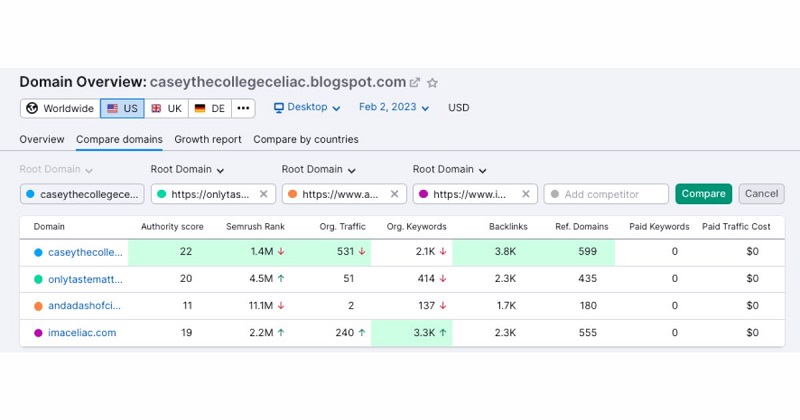
Among its standout features is domain versus domain analysis, offering competitive intelligence through comparing domains. This advanced system reveals crucial details about competitors’ domains, including common keywords and a deep dive into SERPs for each keyword.
In essence, SEMrush serves as an exceptional domain and site authority checker tool, catering to the needs of digital marketers, bloggers, and businesses. Try it out with a subscription starting at $99.95 per month.
4. Ahrefs
Ahrefs stands out as a highly regarded SEO management tool trusted for its capabilities in competitive analysis, keyword research, backlink analysis, content research, rank analysis, and website monitoring.
This tool assists marketers, bloggers, and businesses in monitoring vital elements such as backlinks, anchor texts, referring domains, top landing pages, and competing domains. As these elements collectively contribute to site performance, your website’s domain authority and other metrics will improve significantly.
5 Latest Methods That Help Improving Domain Authority
Due to the reliance on established ranking factors, there is typically a positive connection between a website’s domain ranking and its search engine performance. However, enhancing your website authority is a gradual process. Here are 5 methods to improve a website’s DA.
Method 1: Increase Organic Traffic with Optimized Content
Organic traffic is a factor in calculating the Authority Score, reflecting that a higher volume of organic clicks indicates the content meets Google’s quality standards. Here’s a step-by-step guide on how to create optimized content to boost organic traffic and enhance DA:
Step 1: Conduct keyword research & choose target keywords with substantial search volume and manageable keyword difficulty.
Step 2: Create quality content aligned with the keywords. Consider using SEMrush’s SEO Content Template tool to guide content creation.

Step 3: Build organic landing pages that align with your content goals. This step ensures that your content is well-structured and optimized for search engines.
Step 4: Employ Semrush’s On-Page SEO Checklist to optimize your content further. This checklist covers crucial elements that enhance search engines’ understanding of your content.
By following these steps, you increase your organic traffic and contribute to increasing Domain Authority over time. However, this method requires consistent effort and monitoring to adapt to changing SEO dynamics.
No worries—our dedicated team has a proven track record of content optimization, as seen in our collaboration with ERA Staffing. Contact us today for a personalized strategy and see the results firsthand.
Method 2: Get Quality Backlinks from Authority Sites
Backlinks are links on external websites directing users to your site. Their quality is a focal point for 42% of marketers when evaluating a site’s domain authority. Therefore, the first step to increase domain authority is link-building.
Begin by examining your top referral sources—sites driving traffic to you. Can you secure more links from these domains? Use Google Analytics to find similar sites that may benefit from linking to you and begin outreach efforts.
Another effective strategy is ethical competitor analysis. By analyzing your competitors’ backlink sources, you can identify potential link-building opportunities and aim to gain links from the same reputable websites. To do that, follow these steps:
Step 1: Create link-worthy content.
Step 2: Use Ahref’s Link Building Tool to identify competitors and prospects for backlinks.

Step 3: Enter keywords related to your content and add competitors to the tool to identify potential link-building opportunities.
Step 4: Start the link-building process by collecting and analyzing data through the tool.
Step 5: View a list of prospects with their Authority Scores, helping you identify sites that can provide quality backlinks.
Step 6: Move prospects to the “In Progress” tab, select sites, and start contact through the tool.
See more: Referring Domains Vs Backlinks
Method 3: Remove Bad Links
How can we improve Domain Authority while guarding the website’s rankings? A practical approach is removing bad links.
These harmful or toxic links from spammy websites can significantly decrease your domain authority. Removing them prevents negative impacts on your overall authority score, allowing your site to maintain or improve its standing.
Search engines, notably Google, may penalize websites with spammy or unnatural backlinks. Such penalties can result in a drop in rankings and visibility.
By proactively identifying and removing harmful links, you mitigate the risk of penalties, ensuring your website remains in good standing with search engines.
Therefore, we recommend regularly auditing your site for toxic links using SEO tools like SEMrush’s Backlink Audit tool.
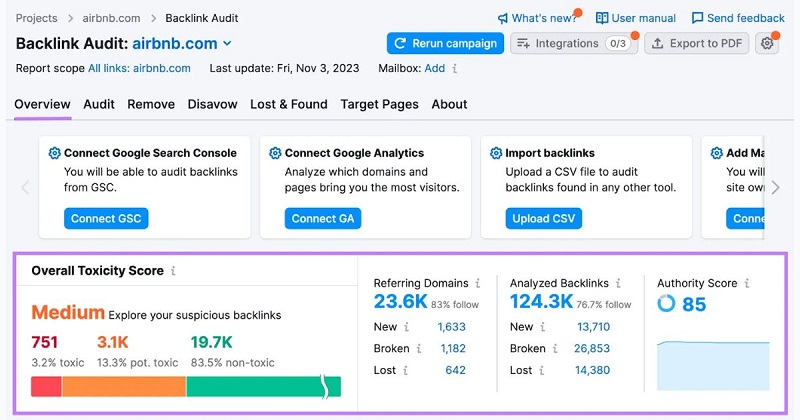
In cases where it’s challenging to remove harmful links manually, Google Search Console provides the option to disavow these links. By disavowing links, you signal to search engines that you don’t want them to consider these links when assessing your website.
However, this should be a last resort, and you should focus on removing links directly.
Method 4: Optimize Your Website Structure and User Experience
Enhancing your website’s user-friendliness is a key strategy for boosting domain authority. A well-organized structure enables seamless navigation for search engines to crawl and index pages.
Also, it ensures users can quickly locate information, increasing the likelihood of them sharing and linking to your content.
Here are vital aspects to optimize your website structure and user experience:
- Crawlability and Indexing: To assist search engine crawlers, create a sitemap. This map includes all crucial pages, aiding seamless navigation and efficient indexing.
- Mobile Optimization: Since Google prioritizes mobile performance, it’s crucial that your site functions well and loads quickly on mobile devices.
- Page Load Speed: Faster-loading pages contribute to a positive user experience, reducing bounce rates and improving rankings.
- Website Security: SSL certificates and robust security measures build user trust and indicate reliability to search engines.
Method 5: Get Listed in Relevant Directories
A cost-effective way to increase domain authority is getting listed in relevant online directories, especially for local or small businesses. This practice enhances your website’s visibility and trustworthiness, positively influencing domain authority.
Inclusion in online directories contributes to your website’s link power—the quantity and quality of your links. These directory listings serve as valuable backlinks, indicating that your business is reputable and relevant to search engines.
As mentioned above, quality backlinks are a key factor in improving domain authority over time.
Moreover, these listings not only bolster your link profile but also improve your local SEO rankings, especially in services like Google Map Pack. Local citations and mentions across directories reinforce your local presence and authority in specific markets or areas.
To start, identify critical online directories relevant to your industry and submit your business listings to these platforms. Try the Listing Management tool if you prefer a more streamlined approach without the manual entry process:
Step 1: Input your website URL and click “Get Free Report.”
Step 2: Scroll down and get information about your online presence, inconsistent listings, and average star rating. The tool also lists directories with unreliable data and platforms where your business listing is absent.
Step 3: To rectify these issues and effortlessly submit your information to relevant directories, click the “Try it now” button at the top of the page.
FAQs
How long does it take to improve domain authority?
Improving domain authority is a long-term strategy that requires time and consistency. It may take weeks or even months of continually building quality links and making enhancements to see noticeable improvements.
Is higher domain authority better?
In general, a higher domain authority is better. However, it’s crucial to consider the relative comparison within your specific industry or niche. A domain authority of 20 might seem low on its own.
Still, if it surpasses the average authority score of websites in your industry, it can be considered relatively good within that context.
Is 35 a good domain authority?
As mentioned above, evaluating the domain authority in relative comparison within your specific industry or niche is crucial. Therefore, the answer depends on the average authority score of websites in your industry.
Conclusion
We hope the 5 methods we have shared above offer a strategic roadmap for you to fortify your online presence. From getting quality backlinks to leveraging the power of online directories, each method is a holistic approach to improving domain authority. And finally, remember to follow us for more valuable guides and tips on optimizing your digital strategy!