
Key Takeaways
- Semantic search focuses on meaning, not just keywords. It uses NLP and machine learning to understand intent, context, and relationships, making results more accurate and people-focused.
- Semantic search improves user experience and ROI. By reducing ambiguity, handling complex queries, and personalizing results, it helps brands build trust, boost conversions, and increase customer loyalty.
- You can build a semantic search engine step by step. From preparing clean data, generating embeddings, and storing them in vector databases to ranking and continuously optimizing, the process ensures smarter, more relevant search results.

Semantic search
Semantic search is redefining how people find and engage with businesses online. Don’t get left behind, partner with ROI Digitally to build an SEO strategy that aligns with user intent and drives measurable ROI.
What Is Semantic Search?
Semantic search is a way of improving search results by focusing on meaning, not just keywords. Instead of simply matching the exact words you type, it looks at the intent behind your query and the relationships between those words.
So, what is semantic search in simple terms? It’s a search that “understands” you. By using natural language processing (NLP) and machine learning (ML), semantic search can figure out what you’re really asking, even if you phrase it differently.
For example, if you search “best laptop for design students,” semantic search doesn’t just match the keywords “laptop” and “design.” It understands you’re likely looking for laptops with specific features like good graphics, fast processors, and portability. This shift makes results more accurate, relevant, and people-focused.

Example of semantic search for the keyword: “best laptop for design students”
In fact, semantic search is at the heart of how modern AI and generative systems work, helping them not just find information but also create content that aligns with your true intent.
Learn more: What Is Topical Authority in SEO (And How to Build It)
How Does Semantic Search Work?
At its core, semantic search is about making search smarter. Instead of just matching words, it focuses on understanding intent and context, giving users results that actually answer their questions. So, how does semantic search work in practice?
- Query Understanding: Using Natural Language Processing (NLP), the system analyzes your query to figure out not just the words, but what you mean.
- Entity Recognition: It identifies key entities, like people, places, products, or concepts, so results are tied to exactly what you’re looking for.
- Semantic Matching: Rather than keyword matching, it compares the meaning of your query with content in its index to surface the most relevant answers.
- Contextual Analysis: It looks at factors like location, history, or preferences to personalize results for each user.
- Ranking for Relevance: Finally, results are ranked based on relevance, authority, and usefulness, ensuring you see the most meaningful content first.
This process evolves constantly. Algorithms learn from signals like bounce rates, conversions, and engagement to fine-tune relevance.
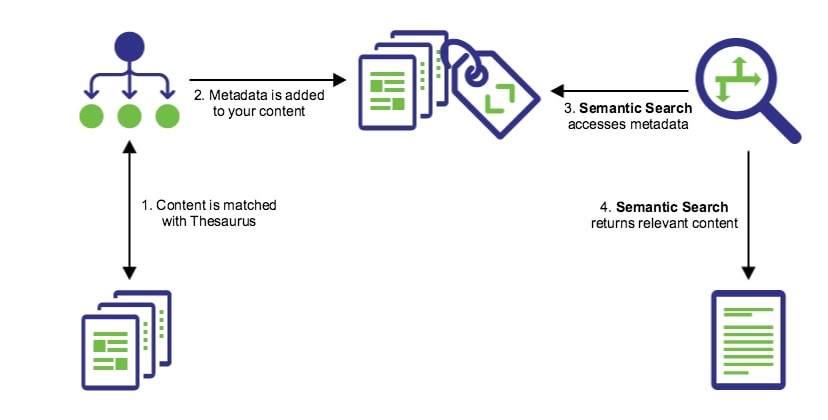
How semantic research works. Source: iMark Infotech Pvt. Ltd.
That’s why, if utilized semantic search correctly, it is a game-changer for businesses aiming to boost user satisfaction, engagement, and ultimately, ROI.
Understanding intent is the heart of semantic search. At ROI Digitally, we structure your content and SEO around meaning, not just keywords, so Google connects your brand with the right audience. Explore our SEO services now!
The Impact of Semantic Search On User Experience
Semantic search is transforming how people interact with digital information and how brands connect with customers. Unlike traditional keyword search, it interprets meaning and intent, so results feel accurate, relevant, and personal. Here’s why this matters:
- Improved Accuracy & Relevance: Traditional search can show you every page that mentions a word. Semantic search goes further by understanding what you meant. If a user searches “running shoes,” the engine knows to prioritize products, not articles about shoe history.
- Enhanced User Experience: Customers don’t want to feel like they’re wrestling with a search bar. By instantly surfacing the right product, service, or content, semantic search reduces frustration. That extra time saved often gets spent exploring more products, lifting metrics like average order value (AOV) and revenue per visitor (RPV).
- Better Handling of Complex Queries: With the rise of voice assistants and conversational search, queries are getting longer and more natural. Instead of “buy laptop,” people say “best lightweight laptop for design students under $1,000.” Semantic search can break that down, identify entities (laptop, design students, budget), and deliver tailored results.
- Reduced Ambiguity: Words with multiple meanings can tank search quality. Think of “tank top” versus “tank engine.” By reading context, semantic search eliminates guesswork, ensuring users find precisely what they want.
- Personalization at Scale: Search doesn’t stop at intent; it adapts to you. If a shopper has previously searched women’s swimwear, then later types “tank top,” semantic search uses that history to prioritize relevant women’s products over men’s. Even misspellings (“rde” instead of “red”) are caught, keeping the journey smooth.
The bigger picture? Semantic search drives both satisfaction and revenue. Customers who feel understood trust your brand more, stay longer, and buy more. For businesses, that means lower bounce rates, higher conversions, and loyal buyers who return again and again.
Learn more: How to Optimize Content for AI Overviews: An Expert Guide
Semantic Search vs Keyword Research
For years, digital marketing lived and breathed around keyword matching. But the way people search has changed. Today, semantic search looks beyond the words we type to truly understand intent, context, and meaning. Here’s how they compare:
| Aspect | Traditional Keyword Search | Semantic Search |
| Keyword Matching vs. Context | Matches exact keywords in a query with web pages. Example: Searching “jaguar” could return results for the animal or the car, without knowing which you meant. | Understands the context and meaning. Example: If you’ve been searching for cars, “jaguar” will prioritize the brand over the animal. |
| Relevance Ranking | Results ranked by keyword frequency, backlinks, or metadata. | Results ranked by how well they fit intent, context, and even user preferences. |
| Handling Ambiguity | Struggles when a word has multiple meanings. | Disambiguates based on context (e.g., “apple” the fruit vs. Apple the brand). |
| Personalization | Everyone sees the same results. | Tailors results by location, history, and preferences. |
| Natural Language Processing (NLP) | Can’t understand conversational queries. | Uses NLP to interpret natural language, making it ideal for voice and AI-driven searches. |
In short, traditional keyword targeting is still useful for SEO, but without aligning it with semantic search optimization, businesses risk being invisible to today’s search-savvy customers.
How To Build Semantic Search Engine
Unlike keyword-based search engines that only match exact words, semantic search is designed to understand meaning. By combining Natural Language Processing (NLP), embeddings, and vector databases, you can build a search system that delivers results based on intent and context. Here’s how the process works:
Step 1: Collect and Prepare Data
- Gather documents or text data: Start with the content you want to make searchable, such as product catalogs, FAQs, blogs, research papers, or knowledge base articles.
- Clean and normalize text: Remove duplicates, fix formatting issues, and standardize text (for example, consistent casing and punctuation).
- Chunk long content: Break large documents into smaller units, like paragraphs or sentences, to improve retrieval accuracy.

To collect and provide precise data/insights is the first step to build semantic search engine. Source: Blog | Databases at CERN blog – CERN
A clean, well-structured dataset is the foundation of a reliable semantic search engine.
Learn more: What is Organic Search? How To Effectively Increase It?
Step 2: Generate Embeddings
- Use pre-trained language models: Tools like BERT, Sentence Transformers, or Cohere can convert text into embeddings, numerical vectors that capture meaning.
- Choose domain-specific models if needed: Specialized models perform better for industries like healthcare, finance, or eCommerce.
- Process all data: Convert every text chunk into embeddings and prepare them for storage.
Embeddings form the core of semantic search, allowing machines to compare meaning rather than keywords.
Step 3: Store in a Vector Database
- Select a vector database: Options such as Pinecone, Milvus, Qdrant, or pgvector are built for high-speed similarity search.
- Index your embeddings: Indexing ensures fast and scalable comparisons between millions of data points.
- Optimize for scale: Vector databases are designed to handle real-time queries even with large datasets.

The workflow of vector search data for semantic search. Source: Medium
This is what makes semantic search efficient and practical at scale.
Step 4: Process Queries
- Convert user queries into embeddings: For example, “best lightweight laptop for design students” is transformed into an embedding.
- Similarity search: The system finds stored embeddings most similar to the query embedding.
- Use similarity metrics: Algorithms such as cosine similarity or Euclidean distance measure closeness in meaning.
This step ensures queries are answered based on meaning, not just surface-level word matches.
Step 5: Rank and Present Results
- Relevance ranking: Results are ordered based on similarity scores, authority of sources, and context.
- Contextual analysis: Factors like user location, history, and preferences can refine results further.
- Clear presentation: Display results with snippets, highlights, or summaries so users can quickly verify relevance.
- Hybrid approach: In some cases, combining semantic and keyword search provides the best balance between breadth and precision.
Ranking and presentation directly impact user satisfaction and trust in the system.
Learn more: 8 Proven Link Building Strategies Marketers Should Utilize
Step 6: Continuous Optimization
- Monitor user signals: Metrics such as click-through rates, bounce rates, and conversions reveal how effective your search engine is.
- Retrain or fine-tune models: As new data is added, update embeddings and improve accuracy.
- Personalization: Use customer profiles and search history to make results more relevant over time.
Semantic search engines improve with feedback, ensuring results stay aligned with evolving user intent.
Frequently Asked Questions
- What is semantic search with an example?
Semantic search is a way of retrieving information based on meaning and intent rather than just keywords. For example, if you search “best laptop for design students,” a semantic search engine understands you’re looking for laptops with strong graphics, speed, and portability.
- Is Google a semantic search?
Yes. Google has used semantic search since introducing the Knowledge Graph in 2012. It interprets queries based on entities, context, and relationships. This is why Google can distinguish between “Amazon” the rainforest and “Amazon” the company, or provide direct answers, featured snippets, and personalized results.
- How to build a semantic search?
To build a semantic search system, start by preparing and cleaning your text data. Convert it into embeddings using AI models like BERT or Sentence Transformers. Store those embeddings in a vector database such as Pinecone or Milvus. When users search, convert their query into an embedding, compare it against stored data, and return ranked results based on meaning and relevance.
- What is semantic search in LLM?
In large language models (LLMs), semantic search refers to finding and retrieving information based on intent and meaning. LLMs use embeddings to understand context and relationships between words.