Search intent is crucial to why your website might not rank for desired keywords. To maximize your SEO strategy and rank higher, you must understand what searchers genuinely want, not just what they express in their searches. But what is search intent? How do we determine search intent and optimize content for it?
This article will answer all these questions and give you comprehensive knowledge about this critical factor. So, read on and optimize your content for higher rankings on the search engines.
What Is Search Intent?
Search intent, or user intent, refers to the purpose behind an online search. It indicates why someone is searching for a keyword, as each search online has a particular goal. These searches often align with different stages in the user’s online journey.
Over time, Google has continually refined its algorithm to better understand people’s search intent. The search engine’s goal is to rank pages that match the search terms and align with the search query’s underlying purpose.

Therefore, to rank on Google, your content needs to be the most relevant for the search query. For example, if you search for “best Toyota,” you’ll see results with Toyota car rankings and reviews, not specific car product pages.
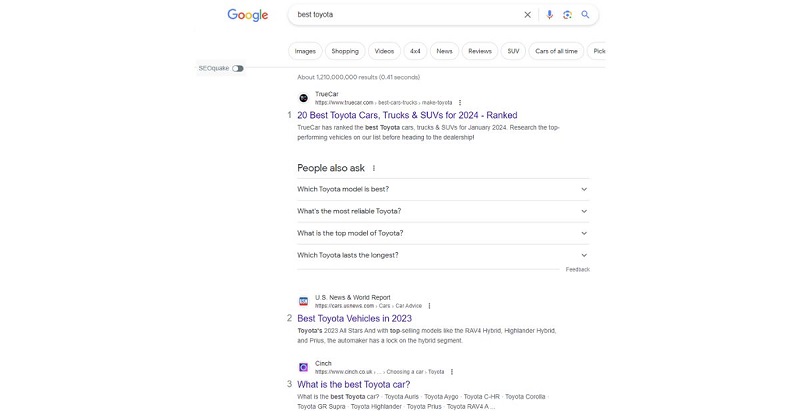
Google understands that users intend to learn before potentially making a purchase, hence the majority of informative content in the results.
Why Is Search Intent Important in SEO?
Beyond only focusing on semantic keywords, understanding users’ search intent brings numerous benefits and can significantly improve your site’s performance:
- Enhanced Search Engine Ranking: Search engines like Google prioritize websites effectively fulfill the searcher’s intent. Therefore, crafting content that matches users’ expectations and needs may bring higher rankings in search results, expanding your website’s overall visibility.
- Increased Click-Through and Conversion: By aligning your content with the searcher’s intent, you increase the possibility of your site ranking in search results. That, in turn, expands the chances of a click-through, conversion, and potentially gaining a loyal customer.
- Targeted Audience Engagement: Understanding search intent helps you create relevant content to attract and potentially convert leads into customers. This approach allows you to build more effective marketing strategies tailored to your customer’s interests.
- Better User Experience: Fulfilling the search intent is an excellent way to provide a better user experience. When your content resonates with what users seek, it proves your website is an authority. Satisfied users are more likely to return, promoting a positive relationship with your audience.
4 Types of Search Intent
There are four types of search intent:
- Informational: Users want to learn more about something.
- Commercial: Users are researching before making a purchase decision.
- Transactional: Users want to complete a specific action, usually making a purchase.
- Navigational: Users are finding a specific page.
Each type showcases the reason behind different online searches. Let’s explore each one in detail.
Informational Intent
People use informational keywords when looking to learn something. They are typically from high-funnel consumers who are just starting their journey and have yet to decide.
These queries often cover broad topics and can begin with words like “Who,” “What,” “When,” “How,” “Guide,” and “Tips.” They can range from simple questions (like “How old is Taylor Swift?”) to more complex ones (like “The composition of black holes”).
Google usually provides quick answers to straightforward questions through featured snippets or knowledge graphs in the search results. Here is an example:

As high-funnel consumers often do these searches, focusing on high-funnel marketing helps create awareness. In this stage, companies make their first impression, aiming to get their name in front of potential consumers at the right time and place.
If you neglect to target high-funnel consumers, you risk them not discovering your brand, products, and services. So, recognizing and addressing informational intent can positively impact your business’s bottom line.
Commercial Intent
Commercial keywords come from users exploring potential investments. These are typically high-to-mid funnel consumers aware of a specific product or service and want to learn more about it and similar offerings.
Results for commercial queries often cover various topics and dive into detailed product features. Modifiers for commercial intent keywords include terms like “Best,” “Vs.,” “Top,” and “Review.”
Below is an example of commercial search intent:

Remember, decision-making often leads to conversions. When someone is researching a product or service and comparing options, they are more likely to convert. Therefore, you should target these consumers and provide them with the information they seek to increase conversion rates.
Transactional Intent
People make transactional search intent when they are ready to take action and make a purchase. These users are at the point of converting, knowing exactly what they want.
Typically, you can spot transactional queries by words like “Cheap,” “Coupon,” “Buy,” and “Order.” These present a user actively looking to make a transaction. Depending on the product and service, local results may appear in the search, giving the best user experience.
For instance, searching for “cheap chevy malibu” suggests a transactional intent related to buying or exploring Chevrolet cars.

Since these searches are from those actively seeking to purchase, being visible in search results is essential. If you don’t appear among these searches, you could miss out on valuable conversions, influencing your bottom line.
Navigational Intent
Finally, navigational keywords come from those seeking specific things, such as a website, product, social media channel, address, email, or business hours. Unlike transactional searches, navigational counterparts don’t have specific modifiers. Here is an example of navigational keywords:
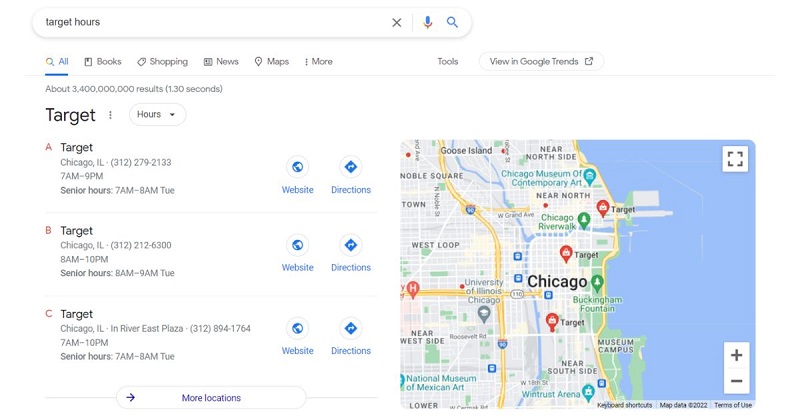
People searching navigational keywords can be at various points in the sales funnel. Specifically, someone looking for “Target hours” might be ready to visit a Target store or seek more information.
Also, searching for “KFC” could indicate someone finding the nearest location or finding the official website.
Navigational queries prompt action, as users are ready to take specific steps. If they’re looking for your brand, that’s great, but if not, you might not rank as well. We recommend using high-funnel marketing and digital PR to drive more navigational keywords.
How to Determine Search Intent?
Beyond understanding “what is search intent?”, you must know that the intent behind each query can change based on the person and the situation. One keyword can be used by different people with different intentions.
While it takes work to know the intent of each search term, follow these approaches as a guide.
Through SERP Features
Keeping an eye on search engine results page (SERP) features enables you to understand search intent. Here’s an analysis of how different SERP features connect with different intents:
| Intent | SERP Features |
| Informational | Answer Boxes, Calculator, Dictionary, Interesting Finds, Knowledge Graph, News, Recipes, Salary Pack, Track a Package, Unit Converter |
| Commercial | Popular Products, Refine By |
| Transactional | Directions, Events, Job Pack, Local, Map Results, Shopping Box |
| Navigational | Sitelinks |
Pro tip: Some SERP features like Ads, Guided Search Filters, Image, Organic, People Also Ask, People Also Search For, Podcasts, Related Searches, or Videos do not specifically imply a particular intent.
Use SEMrush’s Keyword Overview
When searching for a term in Keyword Overview, besides the search volume and keyword difficulty, there’s a column showcasing the intent type:

The calculation depends on the words in the keyword and the features in the search results. Also, you can use a filter to display keywords with a specific intent type exclusively.
But that’s not all: to better understand the search intent and use it in your on-page SEO strategy effectively, analyze the SERP results to understand which pages rank for the keyword. Follow this step-by-step guide:
Step 1: In Keyword Overview, scroll down to the “SERP Analysis” section for this information.

Step 2: Click the search icon. You will see a snapshot of the actual search results and have a better overview of the SERP for your keyword.
Step 3: Analyze the SERP to understand the intent behind a query and gather inspiration from the top results.
See more: Long-tail keywords.
How to Optimize Your Content for Search Intent
Now, let’s learn how to make your content more effective by aligning it with what users seek. Here are some approaches to optimize your content for search intent, ensuring it ranks well and fulfills your customers’ needs.
Method 1: Align Your Content With The 3 Cs Of Search Intent
First, analyze the three Cs: Content type, Content format, and Content angle. These aspects provide valuable insights into users’ preferences and help tailor your content strategy accordingly.
- Content type refers to the dominant type of content in the search results, such as blog posts, videos, product pages, landing pages, etc. For instance, if the first result page for your keyword mainly consists of blog posts, consider starting a blog post.
- Content format relates to the prevailing format of top-ranking pages, typically applying to blog posts. The common formats are how-to guides, step-by-step instructions, list posts, reviews, comparisons, etc.
- Content angle refers to the unique selling point of top-ranking posts and pages, providing insight into what searchers like. If the dominating content angle focuses on the year, such as “2023,” searchers are interested in up-to-date recommendations.
Method 2: Cover Subtopics
Besides the 3 Cs of search intent, covering your topic comprehensively is critical, including subtopics that searchers expect. There are two ways to find subtopics:
Visit the top-ranking pages
Analyzing commonalities among the top-ranking pages tells what users anticipate for a given topic. For instance, leading blog posts for the keyword “best air fryer” recommend the best products in various categories, such as small air fryers suitable for individuals. The presence of different product categories suggests diverse user needs; thus, you should include similar categories in your content.
Run a content gap analysis
Conducting a content gap analysis automates the process of finding common subtopics and crucial points. This method lists keyword rankings for analyzed pages.
Look at this example. When you use Ahrefs’ Keywords Explorer for the keyword “best air fryer,” the Content Gap report reveals common search queries that can serve as subheadings or points for your content.

In a list post about the best air fryers, you can include different topics like:
- Best budget option
- Options based on capacity
- Best innovative air fryer
- Etc.
Pro tip: Some use search volatility to measure search intent clarity.
To assess search volatility, enter your keyword into Ahrefs’ Keywords Explorer. Then, check the SERP position history graph and set filters to “Top 50” and “last 6 months.” Keywords with minimal fluctuation over time mean clear search intent, while those with frequent changes suggest less reliability due to shifting intent.
Method 3: Optimize Content For Search Intent
Each search intent requires specific methods tailored to address the user’s expectations. Here’s a table summarizing strategies to optimize content for different search intents:
| Search Intent | Optimization Strategies |
| Informational Intent | – Observe user search queries to understand informational needs.- Create or enhance content in suitable formats like blogs, FAQs, and how-tos.- Use highly educational content to target users in the early buying stages.- Build trust and authority through informative blog posts. |
| Commercial Intent | – Understand user information needs related to products or services.- Craft landing pages for products and services.- Optimize content types like blogs with detailed product comparisons.- Consider aggregator websites as reliable sources. |
| Transactional Intent | – Add transactional keywords on product landing pages.- Create a seamless transaction experience to encourage repeat or referral business.- Use transactional language across the website to prompt user action. |
| Navigational Intent | – Focus on first-party domains for high click-through rates.- Ensure the technical well-being of the website for top positions in these searches.- Have a comprehensive SEO strategy for brand-related searches.- Focus on local packs, which often appear in location-based transactional intent searches. |
Overall, understanding and aligning content with the intent behind user searches is crucial for effective optimization. So, you need to tailor your content types, formats, and language.
If these tasks sound challenging to you, we are here to help. At ROI Digitally, our expert team will help you optimize your content for user intent. Let us be your partner.
Frequently Asked Questions
What is local search intent?
Local search intent refers to when someone looks for specific information, businesses, or items related to a particular area. It’s often connected with navigational intent, especially when people seek local details.
An example of local search intent is “coffee shops near me.”
How does Google understand search intent?
Google interprets the intent behind a keyword based on the search results.
For example, when a user searches for the keyword “Apple,” the search results will likely show electronic devices from the brand rather than information about the fruit.
Final Thoughts
Once you understand “what is search intent?”, you can provide the best user experience because search continually changes and grows more sophisticated. Remember to align your content with what users seek to improve your chances of ranking higher on Google and build customer confidence. Ultimately, follow us for more valuable insights, and don’t forget to check out our latest blogs about short-tail keywords.