
Key Takeaways
- Topical authority helps you rank better in search results. When your website consistently publishes helpful, in-depth content on a single main subject, Google begins to view you as a trusted expert.
- This SEO factor enhances both user experience and SEO simultaneously. By covering a topic thoroughly with organized content and internal links, you make it easier for both users and search engines to find what they need.
- You can build topical authority through content clusters. Start with a broad topic (pillar page) and create related subtopic pages that link together, showing search engines your depth of knowledge. And other factors can also be implemented while building topical authority.

Topical authority. Source: Tạ Ngọc Hoàng
What Is Topical Authority?
Topical authority is a way of demonstrating to search engines that your website is a trusted expert in a specific subject. In simple terms, your site has a wealth of useful, high-quality content focused on a single main topic and its related subtopics.
Let’s say your website is all about digital marketing. If you regularly publish helpful articles on SEO, content marketing, social media, paid ads, and analytics, Google starts to see you as an expert in that niche. That’s topical authority.
Why Does Topical Authority Matter in SEO?
Topical authority in SEO plays a big role in how well your site ranks on search engines. When your site deeply covers a topic, Google is more likely to trust it and reward it with better visibility in search results. This leads to more clicks, increased visitor numbers, and higher conversion rates.
Building Topical Authority = Better Rankings
The more helpful and complete your content is, the more topical authority your site earns.
It’s not about posting one generic blog post with a few keywords. It’s about covering a topic from multiple angles, using detailed content, real insights, and updated information. That includes related keywords, supporting articles, and strong internal linking, all of which help search engines understand the full scope of your expertise.

The definition of topical authority. Source: How the F*ck SEO
In short, topical authority SEO plays a role in:
- Helping You Rank Higher on Google
Google rewards websites that show expertise and trust in a specific topic. In fact, according to a 2024 survey by Search Engine Journal, over 90% of SEO professionals consider topical authority a key ranking factor. When your site consistently publishes well-researched content on a focused subject, Google sees you as a trusted source and boosts your rankings.
- Improving User Experience and Engagement
Topical authority results in organized content that thoroughly addresses users’ questions. For example, Investopedia ranks well in finance-related searches because it covers a wide range of topics, from basic terms to in-depth guides. This kind of structure not only helps users stay longer on the site but also increases the likelihood they’ll return.
- Aligning With Google’s Semantic Search Approach
Since the Hummingbird update in 2013, Google has focused more on understanding intent rather than exact keywords. That means it favors content that deeply covers a topic and its related subtopics.
Sites with strong topical authority naturally align with this because their content addresses various aspects of a subject, making them more likely to appear in results, even when the keyword isn’t an exact match.
- Allowing Google To Understand Your Site Structure
A website with topical authority usually has a clear internal linking structure and semantically related content. This makes it easier for Google’s crawlers to navigate your site and understand how all the content connects. As a result, your site is more likely to be indexed correctly and shown for relevant queries.
- Driving Long-Term Organic Growth
Unlike keyword-stuffing or shortcut tactics, building topical authority provides sustained SEO benefits. A 2023 Ahrefs study found that domains with topical authority tend to accumulate backlinks naturally and maintain stable rankings over time, even after algorithm updates.
Topical Authority vs Domain Authoriy vs Brand Authority
| Type | Definition | Focus Area | What It Measures | Best For |
| Topical Authority | How well your site covers a specific topic with depth and expertise | Specific subject or niche | Expertise and content depth on one topic | SEO visibility within a niche |
| Domain Authority | An overall score predicting how well a site will rank in search engines | Entire website | Overall ranking strength across all topics | General SEO competitiveness |
| Brand Authority | The level of trust and recognition your brand holds in the market | Market presence & trust | Consumer perception, trust, and influence | Reputation and long-term brand loyalty |
How To Build Topical Authority
1. Choose Your Niche
The first step in building topical authority is picking the right niche. You need a topic that’s focused enough to demonstrate expertise, but broad enough to support numerous related subtopics.
For example, “personal finance for young professionals” is a great niche because it’s specific, yet still allows you to cover many related topics, such as budgeting, credit cards, student loans, and investing.
On the other hand, a topic like “investing in eco-friendly startups” is too narrow for building long-term topical authority. Instead, that could be one subtopic under a broader niche, such as “startup investing.”
If you’re unsure where to start, reflect on your own industry experience:
- What questions do people often ask you?
- What common themes keep showing up in your field?
- What topics can you confidently write or speak about in depth?

Follow 8 factors to find your niche. Source: Lean Marketing
You can also conduct audience research to determine what your ideal readers care about and identify gaps that you can fill with helpful content.
2. Do Keyword Research to Find Relevant Topics
Once you’ve chosen your niche, the next step in building topical authority is keyword research. This helps you discover what your audience is actually searching for, so you can create the right content to match.
To become the go-to expert on a topic, you can’t just write one or two blog posts. You need to cover all the important subtopics. Think of your content as a library, as Google rewards websites that feel complete and well-organized.
For example, if your niche is cooking, don’t stop at recipes. You should also write about:
- Meal planning
- Ingredients
- Cooking tools
- Kitchen tips
- Regional dishes
This demonstrates to Google (and readers) that your site truly knows its stuff, enhancing your topical authority and SEO.
For an efficient keyword research strategy, you can:
- Start broad, then narrow down with tools like Ahrefs, SEMrush, or Google Keyword Planner.
- Use “People also ask” on Google to find questions your audience has.
- Use topic clustering tools to organize keywords into content groups.
- Target both high-volume and long-tail (low competition) keywords.
- Focus on top and mid-funnel content to help users at every stage.

Use tools like Ahrefs, SEMrush to find suitable keywords for ranking. Source: Ahrefs
3. Build Topic Clusters
Once you’ve picked your niche and done keyword research, the next smart step in building topical authority is to organize your content using topic clusters.
A topic cluster is like a mini content ecosystem: you create one main page (called a pillar page) that covers a broad topic, then write several supporting pages about more specific, related subtopics. These pages all link to each other, helping search engines understand the depth of your content.
Think of it like a wheel where:
- The hub (or pillar page) is the main theme (e.g. “Web Design Basics”).
- The spokes (supporting cluster pages) relate to topics such as “Responsive Design,” “Accessibility,” or “User Experience.”
This model helps with:
- Making your site easier for users to navigate.
- Helping Google see that you’ve covered a topic in-depth.
- Matching better with search intent, which boosts your topical authority SEO.

Example of topic clusters for the keyword “workout routines”. Source: Noble Studios
4. Conduct A Thorough Topic Map
Now that you’ve planned your pillar and cluster pages, the next step in building topical authority is to ensure you cover your topic comprehensively.
This means you don’t just write a few random blog posts. Instead, you need to organize your ideas in a structured way so that your site appears to be a true expert in the eyes of both readers and search engines.
This is where a topical map comes in.
A topical map is like a visual plan that shows how your core topic and all its subtopics connect. Imagine a web where the center is your main topic, and each branch connects to smaller, related ideas. You’ll want to make sure your content fills in all those branches.
Here’s how it helps your topical authority SEO:
- It shows Google that you’re covering the topic in-depth.
- It helps you find “easy win” keywords (less competitive topics) and more competitive ones you can tackle later.
- It keeps your content organized and intentional, not scattered.

A structure of a topic map or concept map. Source: UOW
To build your topical map:
- Start with your pillar topic, where the big idea at the center.
- Use keyword tools and brainstorming to identify all related cluster topics.
- Make sure your content speaks to different search intents (answering “how,” “why,” “what,” etc. questions).
- Create useful, high-quality content around those topics that truly helps your audience.
5. Build Backlinks
Even though your own content is the heart of building topical authority, backlinks still matter, a lot.
When other trustworthy websites in your field link to your content, it’s like a vote of confidence that tells search engines, “This site knows what it’s talking about.”
To boost topical authority SEO, these backlinks should come from relevant sites in your niche. For example, if you run a health blog and a respected medical website links to your guide on nutrition, it strengthens your credibility in that topic area.
Here are some simple ways to earn backlinks:
- Write helpful, shareable content: Make guides, infographics, or tutorials that others naturally want to link to.
- Guest post on related blogs: You provide value to them, and in return, you can link back to your site.
- Claim unlinked mentions: If someone mentions your brand online without linking, politely ask them to add the link.
- Use tools like Google Alerts to track new mentions of your name or business.
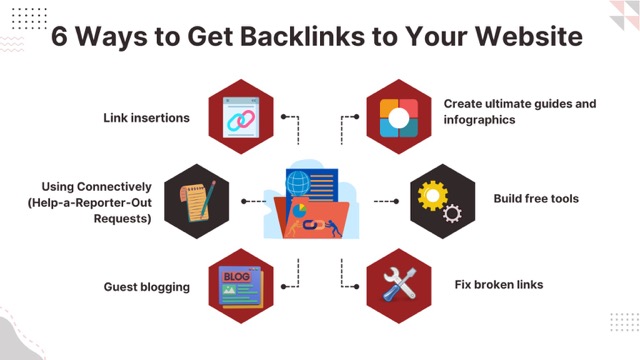
Follow these steps to get backlinks to your website. Source: The HOTH
The goal is quality, not quantity. A few solid backlinks from respected sites in your niche can do far more for your topical authority than a bunch of low-quality ones.
Frequently Asked Questions
1. What is a topical authority?
Topical authority is how much search engines trust your website as an expert on a specific subject. If you consistently publish high-quality, in-depth content about one main topic (and its subtopics), Google sees your site as a reliable source of information for that area. The more valuable and complete your coverage is, the more your authority grows.
2. What is the difference between domain authority and topical authority?
Domain authority assesses your entire website’s overall strength, including backlinks and credibility across multiple topics. Topical authority focuses on how well your site covers one specific subject. For example, a health site with strong domain authority might rank broadly, but a fitness blog with high topical authority in “weight training” could outrank it for related terms.
3. How do you create a topical authority?
To establish topical authority, begin by selecting a distinct niche. Then, create a lot of helpful, well-researched content that covers all angles of that topic. Organize your content into clusters (pillar pages and related subtopics), use internal links, and update your content regularly. It also helps to earn backlinks from other trusted sites in your field.
4. Is topical authority a ranking factor?
Yes, it plays a significant role in SEO success.
Topical authority isn’t a direct ranking factor like page speed, but it strongly influences how Google ranks your content. When Google sees that your site deeply covers a topic and helps users find what they’re looking for, it’s more likely to show your pages higher in search results.