
In the way of master Search Engine Optimization (SEO), you need to know the importance of keyword difficulty. It will be the key to determine your online prospect.
With this expert guide, we will take you on a journey to unravel “what keyword difficulty is” and provide insights that can transform your online visibility and success.
What Is Keyword Difficulty?

Knowing the meaning of keyword difficulty is the first lesson you must learn as an SEO expert. Semantic keywords have conceptual associations with a specified keyword or topic. In contrast, keyword difficulty is a technique applied in SEO to assess how challenging it is to rank highly for a keyword in search engine results pages (SERPs). It helps SEO professionals and website owners understand the competition level for a particular keyword.
A keyword’s difficulty can be based on many factors, including domain authority, page authority, content quality, etc. A higher keyword difficulty score indicates a more challenging environment to rank for that particular keyword. Balancing targeting high-difficulty keywords with strategic, long-tail keywords is essential to optimize your chances of ranking well in search engine results.
Why Does Understanding Keyword Difficulty Matter?
Understanding keyword difficulty’s meaning is instrumental in making well-informed decisions during the content planning and keyword research phases of your search engine optimization (SEO) endeavors—the strategies and techniques employed to enhance visibility in search results. In simple words, keyword difficulty helps you choose the best keywords for SEO.
Exclusively targeting highly challenging keywords might waste time and resources without yielding significant results. Conversely, focusing on easily attainable keywords may lead to missed opportunities for valuable traffic and conversions.
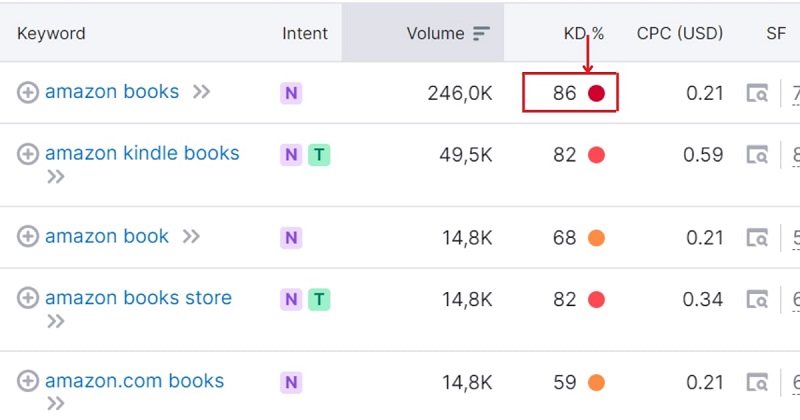
Keyword difficulty expressed as KD% serves as a guide to finding the optimal balance between highly competitive keywords (which may be unattainable) and low-competition keywords (with minimal search interest).

In essence, KD% assists in selecting the most suitable keywords for your site—those capable of generating substantial organic traffic without requiring excessive effort.
What Affects How Difficult A Keyword Is To Rank For?
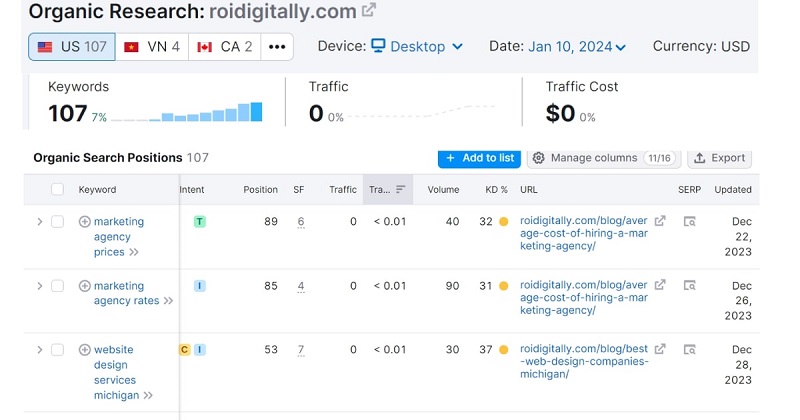
Ranking a keyword brings a moving force for developing your site on a search engine. Making a keyword rank in SEO isn’t simple, as it depends on many factors. Below are those that contribute to determining how difficult a keyword is to rank in search engine results.
- Competition: Many websites and authority websites are trying to rank for the same keyword. Therefore, highly competitive keywords with many authoritative competitors are generally more challenging to rank for.
- Content Quality: The relevance and LSI keyword, or depth and quality of content on pages currently ranking for the keyword matter. Well-optimized and comprehensive content is more likely to rank higher.
- Backlink Profile: The backlinks’ quality and quantity pointing to the pages that rank for a keyword impact its difficulty. With a strong backlink profile, you will have a chance to enhance your page authority and ranking.
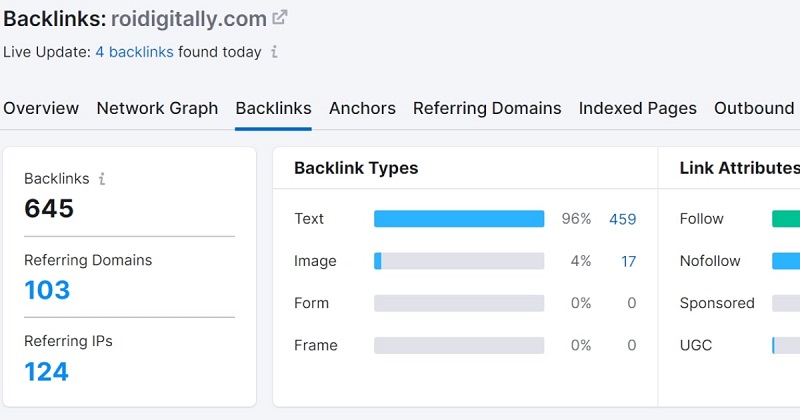
- Domain Authority: You can reach a competitive keyword ranking in SEO when your website is authoritative and trustworthy. Established and reputable websites often find it easier to rank.
- User Intent: It’s crucial to understand and meet the user’s intent when searching a keyword, as search engines tend to rank your site higher when your content is relevant to what users search for.
- On-Page Optimization: Page ranking relies on keyword placement, meta tags, and overall on-page SEO. Your pages will get a higher ranking when you optimize those factors in your content.
- Search Volume: High search volume keywords often have higher competition. However, they also have the potential to bring in more traffic if successfully ranked.
- Algorithm Updates: Search engine algorithms are flexible and can change over time. Updates may impact the ranking difficulty of specific keywords.
When you gain a deeper understanding of those factors and use keyword difficulty measuring tools, you can evaluate your ability to rank for specific keywords. Through it, you can develop effective strategies to improve their visibility in search engine results.
How to Check Keyword Difficulty?

This digital world offers several tools to check keyword difficulty online, ranging from popular platforms to specialized SEO software. In addition, discover how to evaluate target keywords’ level of competition step-by-step to obtain an advantage over competitors in the digital space.
- Use Keyword Research Tools: Apply keyword research tools that provide a keyword difficulty metric. Some best keyword research tools include:
- Ahrefs: Ahrefs is a tool providing a Keyword Difficulty (KD) measure. It will display how difficult a keyword is to rank on a scale from 0 to 100.
- SEMrush: The SEMrush tool is the same as Ahref. It will show you a KD score when you search. Through it, you can determine keyword rank and how hard the keyword is.
- Google Keyword Planner: Google Keyword Planner is a part of Google Ads that helps you estimate a keyword competition. While it doesn’t explicitly offer a “difficulty” score, you can assess competition based on the suggested bid amounts and competition level.
- SEMrush: Besides keyword difficulty, SEMrush provides valuable metrics like search volume, CPC (Cost Per Click), and many search engine results pages (SERPs) for a given keyword.
- Ahrefs: Ahrefs provides a keyword difficulty score and offers insights into the number of backlinks needed to rank for a keyword. This tool can be valuable for assessing the link-building effort required.
- Moz Keyword Explorer: Moz’s Keyword Explorer provides a Keyword Difficulty score and other metrics like organic CTR (Click-Through Rate) and priority.
- Google Search: Conduct a manual search on Google for the target keyword. Evaluate the top-ranking pages and their Authority, content quality, and relevance. It can give you a qualitative understanding of the competition.
- Competitor Analysis: Analyze the top-ranking pages for your target keyword. Look at their backlink profiles, content quality, and other factors to gauge the level of competition.
- Long-Tail Keywords: Consider targeting long-tail keywords, which are more specific and often have lower competition. Tools like Ahrefs and SEMrush can help you find long-tail variations of your target keywords.
- Evaluate SERP Features: Check if there are featured snippets, knowledge panels, or other SERP features for your target keyword. These can impact the difficulty of ranking for that keyword.
- Social Media Signals: Assess the social media presence of content ranking for the keyword. Social signals can indirectly influence visibility despite not being a direct ranking factor.
Remember that keyword difficulty is not an absolute measure and may vary based on your niche and industry. It’s essential to use a combination of tools, manual analysis, and your understanding of the market to make informed decisions about the difficulty of ranking for a particular keyword.
How Do Long-Tail Keywords Impact Keyword Difficulty?

Long-tail keywords can significantly impact keyword difficulty, generally making it easier for websites to rank.
- Lower Competition: Long-tail keywords are typically more specific and have a narrower focus than generic and short tail keywords. Because of their specificity, they often have a lower search volume, which translates to lower competition. Compared to highly competitive short-tail keywords, this lower competition makes it easier for websites to rank for long-tail keywords.
- Targeted Audience: Long-tail keywords are more specific to user intent, addressing niche topics or detailed queries. When you optimize your content for these particular queries, you are more likely to attract a highly targeted audience interested in precisely what you offer. This action can result in higher conversion rates.
- Content Relevance: Long-tail keywords allow you to create more relevant and specific content. Search engines typically aim to deliver users the most pertinent query results. You may improve your search engine rankings by producing material that exactly fits user searches by concentrating on long-tail keywords.
- Increased Click-Through Rates (CTR): Users searching for long-tail keywords often have a clearer idea of what they want. If your material is relevant to their needs, they will likely click on your link. Higher click-through rates can positively influence your overall search engine performance.
- Enhanced User Experience: Long-tail keywords help you create content that addresses your target audience’s needs and questions. This content contributes to a better user experience, which search engines value. User satisfaction has an indirect effect on your website’s overall SEO.
- Builds Authority Gradually: Starting with long-tail keywords enables you to build Authority gradually. You can target more competitive keywords as your website gains credibility and relevance in your niche. This strategic approach allows you to grow your online presence over time.
For instance:
If you’re selling handmade leather bags, try to rank for a common keyword like “leather bags”. It is tough because it’s highly competitive.
Instead, if you focus on a specific and detailed long-tail keyword like “handmade brown leather bags for men,” you face less competition. This makes ranking higher in search results easier and attracts customers looking for precisely what you offer.
While long-tail keywords can be advantageous, balancing your keyword strategy is essential. A blend of short-tail and long-tail keywords can help you maximize your reach, target specific audience segments, and gradually increase your website’s authority in the eyes of search engines.
Frequently Asked Questions
Why Is Keyword Difficulty Significant In SEO?
Keyword difficulty plays a significant role in SEO because it helps you evaluate the feasibility of ranking for a particular keyword. Through it, you can do SEO optimization to develop your site effectively. It guides strategic decisions, allowing for targeting keywords that align with the site’s Authority and resources.
What Factors Contribute to Keyword Difficulty?
Several factors contribute to Keyword Difficulty, in making an effective SEO strategy for your site such as:
- Competition from other websites: High competition will make the keyword more difficult.
- The relevance of content to the search intent: Content should include keywords that meet informational, relevant, or transactional user needs for optimal results.
- The quality of backlinks: The backlink can make the site more authoritative and give the keyword a high ranking.
- On-page optimization: On-page SEO factors such as title tag, meta description, URL, and content can affect keyword difficulty. Therefore, making good optimization can improve ranking chances.
- The overall website authority: A website with a better authority typically ranks higher. If your site has lower authority than competitors, ranking for KD can be challenging.
How Can I Check The Keyword Difficulty For A Specific Keyword?
Some SEO tools are available to help you check the keyword difficulty for a specific keyword:
- Ahrefs
- SEMrush
- Moz
- Google Keyword Planner
They will provide insight information on a competitive keyword, then you can have an overall look to make an informed decision for the keyword.
Is There A Universal Scale for Keyword Difficulty?
Different tools use their scales to measure keyword difficulty. For example, Ahrefs uses a scale from 0 to 100, where higher scores indicate higher difficulty. It’s essential to understand the scale specific to your tool.
In summary, acknowledge “What is keyword difficulty?” is your guide to conquering the SEO landscape. Armed with insights on importance and tools, you’re ready to boost your website’s visibility. Stay adaptable, embrace the SEO journey, and let keyword difficulty be your stepping stone to online excellence.